





NAND Flash is one of the most important cost components in an SSD.
For SSD distributors, PC OEMs, system integrators and other buyers, changes in NAND Flash prices can directly affect:
- SSD purchasing costs
- Product quotations
- Distributor margins
- Inventory decisions
- Retail pricing
- Long-term supply planning
But NAND pricing does not move simply because consumer SSD demand goes up or down.
In 2026, the market has been increasingly influenced by AI infrastructure, enterprise SSD demand, NAND supply allocation and supplier production strategies.
So, what is happening in the NAND Flash market, and what should SSD buyers pay attention to?
1. NAND Flash Prices Are Rising — But the Market Is Changing
According to TrendForce’s latest market outlook, NAND Flash contract prices are expected to increase by approximately 10%–15% QoQ in 3Q26. This represents a slower increase than the extremely sharp price increases seen earlier in 2026, but it still indicates continued upward pricing pressure.
The moderation is partly related to weaker consumer demand and the fact that NAND prices have already reached high levels.
However, the underlying supply-demand structure remains tight.
This creates an important distinction for SSD buyers:
A slower rate of price increase does not necessarily mean that SSD prices are returning to previous levels.
For distributors and OEMs, procurement decisions therefore need to consider both current pricing and the direction of the NAND market.
2. Why Is NAND Flash Getting More Expensive?
Several factors are influencing the current NAND market.
AI and Data Center Demand
One of the biggest changes in the NAND market is the rapid growth of AI-related storage demand.
AI workloads require large amounts of storage for:
- Учебные наборы данных
- Inference workloads
- Model data
- KV cache
- High-speed data processing
- Enterprise storage infrastructure
Counterpoint Research reported that Enterprise SSDs accounted for 48% of global NAND bit shipments in Q2 2026, up from 26% a year earlier. It expects server Enterprise SSDs to absorb more than half of NAND bits by the end of 2026.
This is significant because Enterprise SSDs generally represent higher-value products than many consumer storage applications.
As demand shifts toward these products, NAND suppliers have stronger incentives to allocate production capacity toward enterprise applications.
3. NAND Supply Is Being Reallocated
NAND Flash manufacturers do not simply produce one type of product.
The same NAND supply chain supports multiple applications, including:
- Enterprise SSDs
- Client SSDs
- Consumer SSDs
- Смартфоны
- Memory cards
- USB storage
- Embedded storage
When demand from one segment becomes significantly stronger, suppliers can adjust capacity allocation accordingly.
TrendForce has noted that NAND suppliers are allocating more capacity toward Enterprise SSDs, supported by AI and data center demand, while consumer demand remains weaker.
This can create a situation where:
Strong Enterprise Demand
↓
More NAND Capacity Allocated to Enterprise SSDs
↓
Less Flexible Supply for Other Applications
↓
Higher Cost Pressure for Consumer / Client SSDs
This is one of the key reasons SSD buyers should monitor the NAND market instead of looking only at retail SSD prices.
4. Why SSD Prices Do Not Always Move With NAND Prices Immediately
There is not a direct one-to-one relationship between NAND Flash prices and SSD retail prices.
An SSD’s final cost also includes:
- Флэш-память NAND
- Контроллер
- DRAM / HMB
- PCB
- Firmware development
- Testing
- Packaging
- Logistics
- Manufacturing
- Warranty and after-sales costs
In addition, different companies may have different inventory positions.
Например:
Supplier A
Purchased NAND at lower prices several months ago.
Supplier B
Needs to replenish NAND at today’s higher prices.
Even if both suppliers sell similar SSDs, their short-term cost structures may be different.
This is why SSD quotations can vary significantly during periods of rapid NAND price movement.
5. Inventory Can Change the Impact of NAND Price Changes
Inventory is particularly important for distributors.
Suppose a distributor purchased a large amount of SSD inventory before NAND prices increased.
The distributor may temporarily maintain lower selling prices.
However, when that inventory is depleted, the distributor needs to replenish stock at the new market cost.
This creates a potential delay between:
NAND Price Increase
и
SSD Selling Price Increase
The same principle works in reverse when NAND prices decline.
Therefore, buyers should avoid evaluating market conditions based only on today’s SSD retail price.
Instead, they should consider:
- Current NAND prices
- Supplier inventory
- SSD inventory
- Contract pricing
- Lead times
- Expected demand
- Future procurement requirements
6. What Does This Mean for SSD Distributors?
For distributors, NAND price volatility can directly affect margins.
Imagine a distributor purchases SSDs at:
$50 per unit
and sells them at:
$60 per unit
The gross price difference is $10.
But if NAND prices rise significantly and the replacement cost increases to:
$57 per unit
the same $60 selling price leaves much less room for margin.
At the same time, distributors cannot always increase retail prices immediately because of:
- Competitor pricing
- Existing customer quotations
- Channel agreements
- Market demand
- Inventory already in the channel
Therefore, procurement timing becomes increasingly important.
7. Should Distributors Buy More SSD Inventory When NAND Prices Rise?
There is no universal answer.
Buying more inventory can protect against future cost increases, but excessive inventory can create another risk.
If the market unexpectedly weakens and prices decline, distributors holding expensive inventory may face:
- Lower margins
- Inventory depreciation
- Slower turnover
- Greater working-capital pressure
A better approach is to balance:
Market Price
Inventory Level
Customer Demand
Lead Time
Supplier Capacity
Expected Market Direction
Rather than simply buying more because prices are rising.
8. Why Long-Term Supply Relationships Matter
The current NAND market also highlights the importance of supply relationships.
As AI and data center demand increases, some large customers are securing supply through longer-term agreements.
Counterpoint’s recent analysis of SanDisk’s investor strategy, for example, noted that long-term agreements are being used to secure committed volumes and provide greater pricing visibility.
For smaller OEMs and distributors, this creates a potential challenge:
Access to supply can become almost as important as the quoted unit price.
A supplier offering the lowest price today may not necessarily provide the most competitive total cost over the next six or twelve months.
9. What Should SSD Buyers Evaluate Besides Price?
When NAND prices are volatile, buyers should avoid comparing suppliers based solely on the current quotation.
Instead, consider at least five factors.
1. Product Cost
Is the current quotation competitive?
2. Supply Stability
Can the supplier maintain consistent supply when upstream costs increase?
3. Product Consistency
Will the same SKU maintain consistent:
- Конфигурация NAND
- Контроллер
- Firmware
- Производительность
across production batches?
4. Lead Time
Can the supplier support the required delivery schedule?
5. Technical Support
Can the supplier support:
- Compatibility testing
- Firmware issues
- Quality problems
- RMA handling
- OEM customization
?
This creates a more complete procurement evaluation:
Price + Quality + Supply + Consistency + Support
10. Why the Cheapest SSD Is Not Always the Best Choice
When NAND prices rise, some buyers may try to reduce costs by selecting the cheapest SSD available.
But a lower quotation can sometimes reflect differences in:
- Качество NAND
- NAND sourcing
- Контроллер
- Firmware
- Производительность
- Выносливость
- Testing standards
- Warranty support
For OEM and distribution businesses, the real cost of an SSD is not only its purchase price.
It can also include:
Purchase Cost
Inventory Cost
RMA Cost
Technical Support Cost
Replacement Cost
Lost Customer Cost
Therefore, a reliable supplier can potentially create more value than a supplier offering only the lowest initial quotation.
11. What Should OEM Buyers Do in a Rising NAND Market?
For OEM customers, procurement planning becomes particularly important when upstream prices are increasing.
Instead of waiting until inventory is nearly exhausted, buyers can consider:
Monitor NAND Trends
Track NAND Flash contract and spot pricing.
Forecast Demand
Estimate SSD requirements for the coming months.
Discuss Supply Plans Early
Communicate expected volume with suppliers in advance.
Validate Multiple Product Options
Prepare alternative capacities or product tiers where appropriate.
Evaluate Total Cost
Consider price together with quality, consistency and supply reliability.
The goal is not necessarily to predict the exact NAND price at the bottom or top.
The goal is to reduce procurement uncertainty.
12. What Does the Current Market Mean for Consumer SSDs?
The current NAND market is increasingly divided between different demand segments.
On one side:
AI / Data Center / Enterprise SSD Demand
continues to grow strongly.
On the other:
PC and Consumer Storage Demand
remains more price-sensitive.
TrendForce noted that elevated client SSD prices and high OEM inventory have made PC buyers less willing to accept another major round of increases, leading to more prolonged price negotiations in the client SSD market.
This means consumer SSD suppliers face a difficult balance:
Higher NAND Costs
vs.
Limited Consumer Price Tolerance
For SSD brands and suppliers, controlling product costs while maintaining quality becomes increasingly important.
13. What This Means for SSD Suppliers
The current NAND market also changes the role of an SSD supplier.
A supplier cannot simply purchase NAND and assemble SSDs.
A competitive SSD supplier needs to manage:
- Component sourcing
- NAND selection
- Controller selection
- Firmware
- Product qualification
- Quality control
- Production planning
- Inventory
- Supply stability
- Customer support
In a volatile market, these capabilities become even more important.
14. Oreton’s Approach to SSD Supply
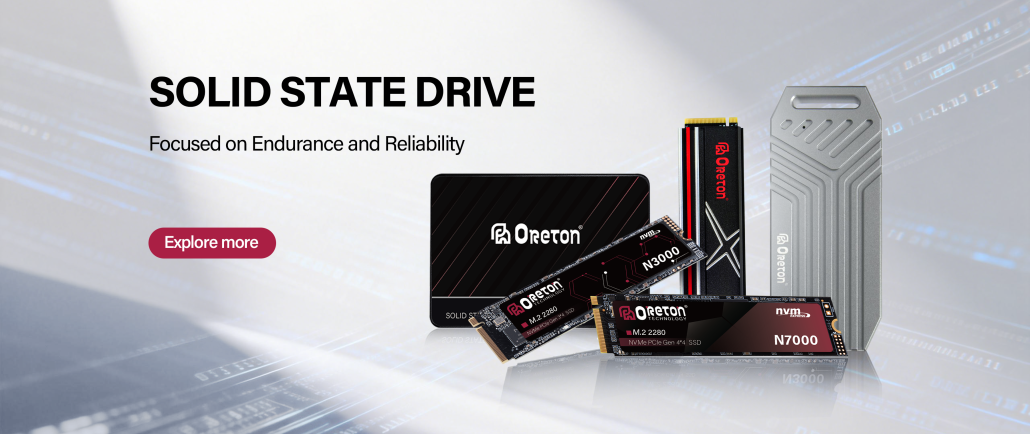
As an SSD and memory supplier, Oreton understands that B2B customers need more than a competitive quotation.
When upstream NAND prices and supply conditions change, customers also need:
Stable Product Quality
Consistent Specifications
Reliable Supply
Technical Support
Flexible Product Planning
For distributors and OEM customers, our focus is to build SSD products around a balance of performance, quality, cost and supply stability.
This means considering the complete product structure, including:
- Флэш-память NAND
- Контроллер
- Firmware
- Вместимость
- Интерфейс
- Производительность
- Thermal characteristics
- Quality validation
We also recognize that product consistency is critical for long-term B2B
relationships.
For customers purchasing SSDs for distribution or OEM integration, the objective should not simply be to find the lowest price available today.
It should be to establish a supply solution that remains competitive and reliable as market conditions change.
15. What Should SSD Buyers Watch Next?
For the remainder of 2026, buyers should continue monitoring several indicators:
NAND Contract Prices
These provide an important indication of upstream cost trends.
Enterprise SSD Demand
AI infrastructure continues to influence NAND allocation.
NAND Supplier Capacity Allocation
Changes in capacity allocation can affect supply available for client and consumer SSDs.
OEM Inventory
High inventory can temporarily reduce buyers’ willingness to accept higher prices.
Consumer Demand
Weak consumer demand can limit how much of the upstream cost increase can be passed through.
Long-Term Supply Agreements
More contracted supply can change the balance between spot-market and contracted buyers.
Заключение
NAND Flash pricing is no longer simply a matter of consumer electronics supply and demand.
The rapid expansion of AI infrastructure is changing how NAND capacity is allocated across the market.
According to Counterpoint Research, Enterprise SSDs already represented 48% of global NAND bit shipments in Q2 2026, nearly double the share from a year earlier.
At the same time, TrendForce expects NAND Flash contract prices to rise another 10%–15% QoQ in 3Q26, although the pace of increase has moderated as consumer demand weakens and prices reach higher levels.
For SSD distributors and OEM buyers, the key lesson is clear:
Don’t evaluate an SSD purchase based on today’s price alone.
A stronger procurement strategy considers:
NAND Market Trends
SSD Pricing
Стабильность поставок
Product Quality
Inventory
Long-Term Supplier Support
As the NAND market continues to evolve, buyers who understand the relationship between upstream NAND costs and downstream SSD pricing will be better positioned to manage purchasing decisions, protect margins and build more resilient supply chains.
Market prices will change. A reliable supply strategy should be built to adapt with them.