





Memory pricing has become a much more important consideration for OEMs, PC manufacturers, distributors, and system integrators in 2026.
DRAM is no longer simply a standardized component that can be purchased based on capacity and frequency. Changes in AI infrastructure demand, server memory requirements, HBM production, DDR5 adoption, DDR4 supply, and overall semiconductor capacity are increasingly influencing both memory availability and pricing.
For companies purchasing memory for long-term projects, this creates a more complicated procurement environment. A supplier offering the lowest price today may not necessarily provide the lowest overall procurement cost over the life of a project.
Understanding the relationship between DRAM market trends, memory component costs, supply stability, and supplier capabilities is therefore becoming increasingly important.
1. The Memory Market Is Being Reshaped by AI Demand
One of the most important developments in the memory market is the rapid growth of AI infrastructure.
AI servers require large amounts of high-bandwidth memory (HBM), server DRAM, and increasingly high-capacity storage. As manufacturers prioritize higher-value memory products and allocate production capacity toward AI-related demand, conventional DRAM products can also be affected.
TechInsights describes the current memory market as undergoing a structural shift, with AI demand putting increasing pressure on available memory supply and hyperscalers securing long-term DRAM commitments.
TrendForce has similarly highlighted the structural impact of AI infrastructure on the memory market. Its 2026 outlook projected the global memory market could reach approximately $551.6 billion in 2026, with further growth toward 2027 as AI-related memory demand continues to expand.
This does not mean every type of DRAM moves in exactly the same direction. However, it does mean that memory procurement decisions are increasingly connected to broader semiconductor supply allocation.
For OEM buyers, the key issue is therefore not simply:
“What is the current price of DDR4 or DDR5?”
The more important question is:
“How stable will the price, availability, and supply of this memory specification be throughout the project?”
2. DDR5 Demand Is Rising, While DDR4 Remains an Important Procurement Category
DDR5 has become increasingly important as newer PC platforms and server systems adopt the technology. At the same time, DDR4 remains widely used in existing PC platforms, embedded systems, upgrades, and cost-sensitive applications.
This creates an interesting situation for OEM procurement.
TrendForce’s recent market updates have shown strong DDR5 demand while tight DDR4 supply has also kept pressure on DDR4 pricing. In some cases, buyers facing higher DDR4 prices have even shifted toward older DDR3 solutions where platform requirements allow it.
This illustrates an important point:
Memory technology transitions do not always happen in a simple linear direction.
A newer generation may become the preferred technology for new system designs, while an older generation can become more difficult or expensive to source as production capacity is gradually reallocated.
For OEMs, this makes product lifecycle planning particularly important.
A memory specification that is inexpensive and readily available today may become more difficult to source later, especially if the project requires the same DRAM IC, module organization, capacity, or electrical characteristics for an extended production period.
3. Memory Prices Are No Longer the Only Procurement Variable
When memory prices move quickly, it is tempting to compare suppliers primarily by unit quotation.
For example, Supplier A may quote a lower price than Supplier B for a 16GB DDR4 module.
However, the actual procurement cost can also be affected by:
- Component availability
- Lead time
- MOQ
- Price validity period
- Batch consistency
- Production capacity
- Quality control
- RMA rate
- Component changes
- Logistics
- Inventory requirements
- Engineering support
A lower initial quotation does not necessarily result in a lower total cost.
This is particularly important for OEM projects.
If a supplier cannot maintain stable component sourcing, an OEM may need to revalidate a memory module, adjust system BIOS settings, repeat compatibility testing, or manage additional inventory.
These costs may not appear on the original purchase quotation, but they can have a significant impact on the total project cost.
4. DRAM IC Cost Is Only One Part of Memory Module Pricing
The price of a finished memory module is influenced by the cost of the DRAM IC, but the relationship is not simply one-to-one.
A finished module also involves:
DRAM IC → PCB → Module Design → SPD Configuration → Assembly → Testing → Quality Control → Packaging → Logistics
Different module specifications can also require different component configurations.
Capacity, DRAM density, IC organization, rank configuration, frequency, timings, PCB design, and platform requirements can all influence the final product.
For example, two 16GB DDR4 modules may have the same capacity and rated frequency but use different DRAM IC configurations or PCB designs.
Their manufacturing cost, compatibility characteristics, and target applications may therefore be different.
This is why professional memory procurement should evaluate the complete module specification, rather than comparing only capacity and price.
5. Supply Stability Has Become a Cost-Control Strategy
In a stable market, companies can often focus heavily on price competition.
In a volatile market, however, supply stability itself becomes part of cost control.
Consider an OEM project that requires 10,000 memory modules every month.
If the supplier can provide a stable component source, consistent specifications, and predictable lead times, the OEM can plan production and inventory more efficiently.
If supply becomes unpredictable, the OEM may need to:
- Purchase additional inventory
- Place orders earlier
- Accept alternative components
- Requalify products
- Adjust production schedules
- Carry higher safety stock
The additional cost can easily offset a small difference in the original unit price.
This is why experienced procurement teams increasingly evaluate suppliers based on both price competitiveness and supply reliability.
6. Long-Term OEM Projects Require More Than Spot Purchasing
Spot purchasing can work well when the requirement is small, short-term, or highly flexible.
Long-term OEM projects are different.
A product may remain in production for several quarters or even several years. During that period, DRAM availability, component pricing, semiconductor production priorities, and platform requirements may change.
For this reason, OEM memory procurement should consider several questions at the beginning of a project:
Can the supplier maintain the required specification?
Can the supplier provide consistent batches?
How are component changes managed?
Can alternative DRAM ICs be qualified if necessary?
How long can the supplier support the product lifecycle?
How quickly can the supplier respond to changes in demand?
These questions are often more important than a small difference in the initial quotation.
7. Component Changes Need to Be Managed Carefully
One of the challenges in a changing DRAM market is that suppliers may need to adjust component sourcing.
A change in DRAM IC does not automatically mean the new component is unsuitable.
However, changing the IC can affect:
- Memory organization
- Rank configuration
- Horários
- SPD parameters
- Compatibilidade
- Thermal behavior
- Overclocking characteristics
- System stability
For OEM customers, uncontrolled component substitutions can create additional validation work.
A professional memory supplier should therefore have a clear process for component change management.
This can include engineering evaluation, sample validation, platform testing, production verification, and communication with customers before a major component change is introduced.
For long-term projects, this level of control can be just as important as the initial product specification.
8. The Role of a Memory Supplier Is Changing
The current memory market is making the role of a supplier more important.
A supplier is not simply expected to provide a product at a competitive price.
For OEMs and distributors, a capable memory supplier can also provide:
Market awareness
Understanding changes in DRAM supply, pricing, product lifecycle, and technology transitions can help customers make better purchasing decisions.
Component sourcing
Access to suitable DRAM ICs and alternative sourcing options can reduce the risk of sudden supply disruption.
Engineering support
Memory module design, SPD configuration, platform compatibility, and validation become particularly important when customers require customized specifications.
Production consistency
Stable component sourcing and controlled manufacturing processes help maintain consistency between batches.
Supply planning
Better communication regarding demand forecasts, production schedules, and lead times can help customers manage inventory more effectively.
The value of a supplier therefore extends beyond the unit price printed on a quotation.
9. A More Practical Approach to Memory Procurement
For OEMs, distributors, and system integrators, a more balanced procurement strategy can be built around five areas:
Market
Monitor DRAM pricing, supply allocation, DDR4/DDR5 transitions, and broader semiconductor market conditions.
Specification
Evaluate not only capacity and frequency, but also DRAM density, IC organization, rank, timings, PCB design, and platform compatibility.
Supply
Consider lead time, production capacity, component availability, MOQ, and long-term product lifecycle.
Quality
Review validation procedures, batch consistency, testing standards, traceability, and RMA management.
Total Cost
Look beyond the initial quotation and consider inventory, requalification, logistics, quality issues, and potential supply disruptions.
This approach helps buyers avoid making procurement decisions based solely on short-term price differences.
10. What This Means for Memory Suppliers
The current market also creates a higher standard for memory module suppliers.
As DRAM prices and supply conditions become more volatile, suppliers need to manage both cost and continuity.
For a manufacturer, this means maintaining relationships with reliable component sources, understanding different DRAM IC options, controlling module design, validating platform compatibility, and maintaining consistent production quality.
It also means communicating with customers more effectively.
For long-term OEM programs, customers may need visibility into:
- Expected lead times
- Component availability
- Ciclo de vida do produto
- Potential specification changes
- Production capacity
- Quality control
- Forecast requirements
This type of cooperation allows both sides to manage market volatility more effectively.
11. Oreton: Memory Supply with a Focus on Consistency
Em Oreton, we understand that memory procurement is not only about finding the lowest available quotation.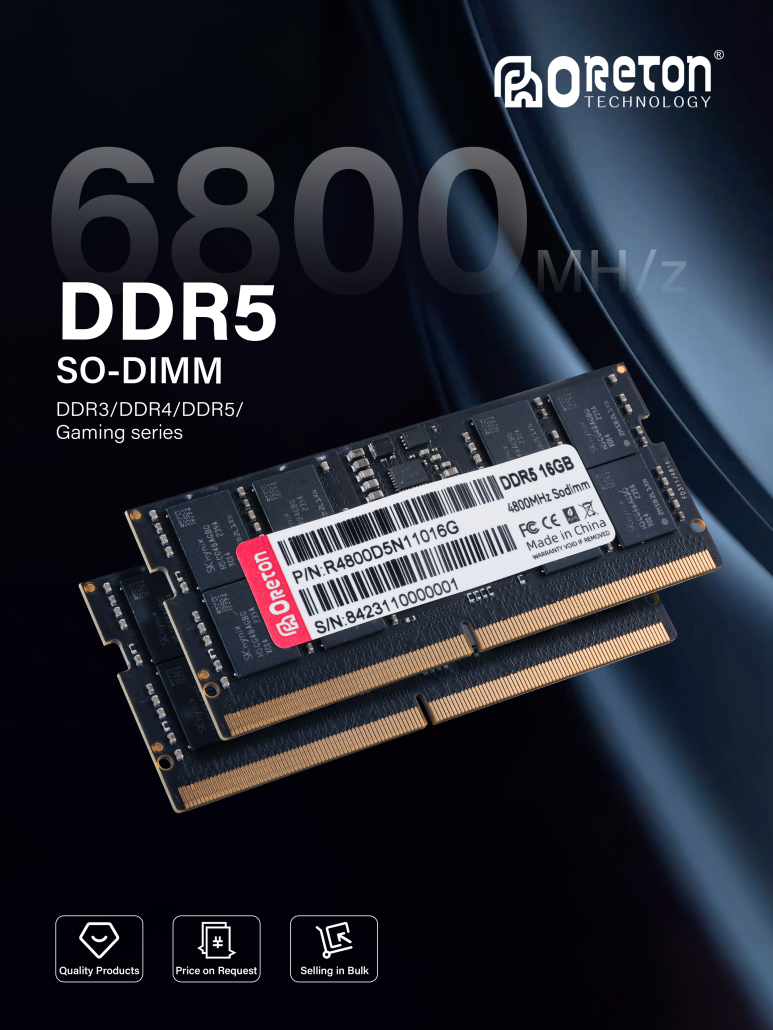
As a DRAM and memory module manufacturer, we work across the process from DRAM IC selection and module design to testing, quality control, and production supply.
Our memory solutions cover DDR4 and DDR5 applications, with attention to platform compatibility, module configuration, production consistency, and long-term supply requirements.
For OEM and distribution customers, our goal is to provide a stable memory supply that balances specification, cost, quality, and availability rather than focusing on a single purchasing variable.
In a market where memory prices and supply conditions can change quickly, a reliable supplier can help customers reduce procurement uncertainty and maintain more predictable product planning.
Conclusão
The memory market in 2026 is being shaped by more than traditional PC demand.
AI infrastructure, HBM, server DRAM, DDR5 adoption, DDR4 lifecycle changes, and constrained semiconductor capacity are increasingly influencing the broader DRAM supply chain. Industry research from TrendForce and TechInsights points to a market where memory demand and supply allocation are becoming more strategically important.
For OEMs, distributors, and system integrators, this means memory procurement should move beyond a simple “lowest price wins” approach.
A more reliable strategy considers:
Price + Specification + Quality + Supply Stability + Lifecycle + Total Cost
The right memory supplier is therefore not necessarily the one offering the lowest price today, but the one that can help maintain a competitive and reliable supply throughout the life of the project.