





As DDR5 matures, frequencies beyond 6400MHz are no longer niche. Modules rated at 6800MHz, 7200MHz, and even higher are widely available in the market.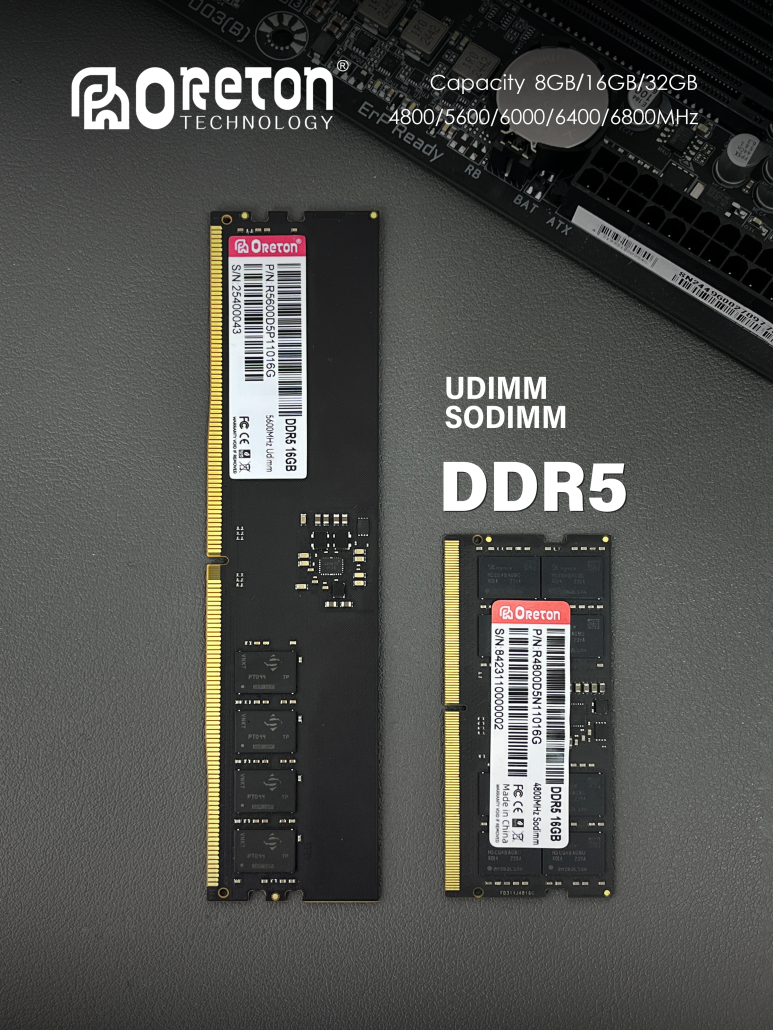
But one fundamental question remains:
Where is the real stability boundary of high-frequency DDR5?
Peak frequency numbers are easy to advertise. Sustained stability across different motherboards, CPUs, and long-term workloads is far more complex.
1. DDR5 Frequency Scaling: What Changes Beyond 6400MHz?
Compared to DDR4, DDR5 introduced:
-
On-die ECC (for internal cell correction)
-
Dual 32-bit subchannels per DIMM
-
Zintegrowany układ scalony PMIC (Power Management IC)
-
Higher base frequency starting at 4800MT/s
However, once frequency exceeds 6400MT/s, multiple physical and electrical constraints begin to surface:
-
Signal integrity challenges
-
Voltage stability sensitivity
-
IMC (Integrated Memory Controller) limitations
-
PCB trace quality on motherboard
High frequency is no longer just a memory module parameter — it becomes a system-level engineering issue.
2. The CPU Factor: IMC Determines the Ceiling
Memory stability above 6400MHz depends heavily on the CPU’s integrated memory controller (IMC).
Na przykład:
-
Intel 12th / 13th / 14th Gen desktop CPUs typically officially support DDR5 up to 5600–6000MT/s (depending on SKU).

-
AMD Ryzen 7000 series commonly lists DDR5 5200–5600MT/s as official support, with 6000MT/s often considered the “sweet spot.”
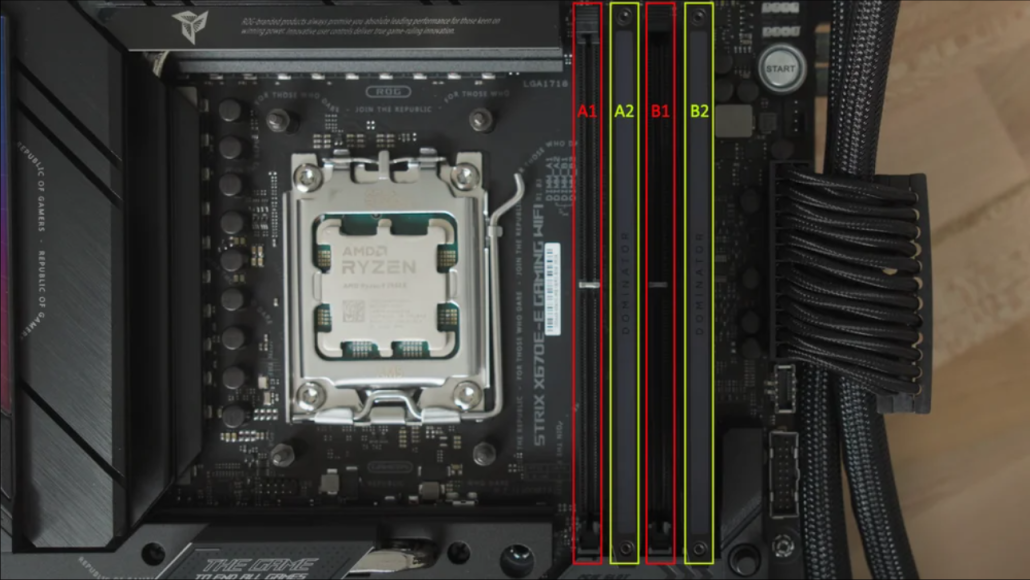
Running memory at 6800MHz+ usually means:
-
Enabling XMP or EXPO profiles
-
Operating beyond official JEDEC specification
-
Increased IMC voltage tuning
-
Greater variability between individual CPUs (silicon lottery)
Two identical CPUs can exhibit different stability ceilings at high frequencies.
To sprawia, że compatibility consistency across batches a real challenge in B2B deployments.
3. Motherboard Topology: Daisy Chain vs T-Topology
Motherboard design directly affects high-frequency DDR5 stability.
Two common memory trace topologies: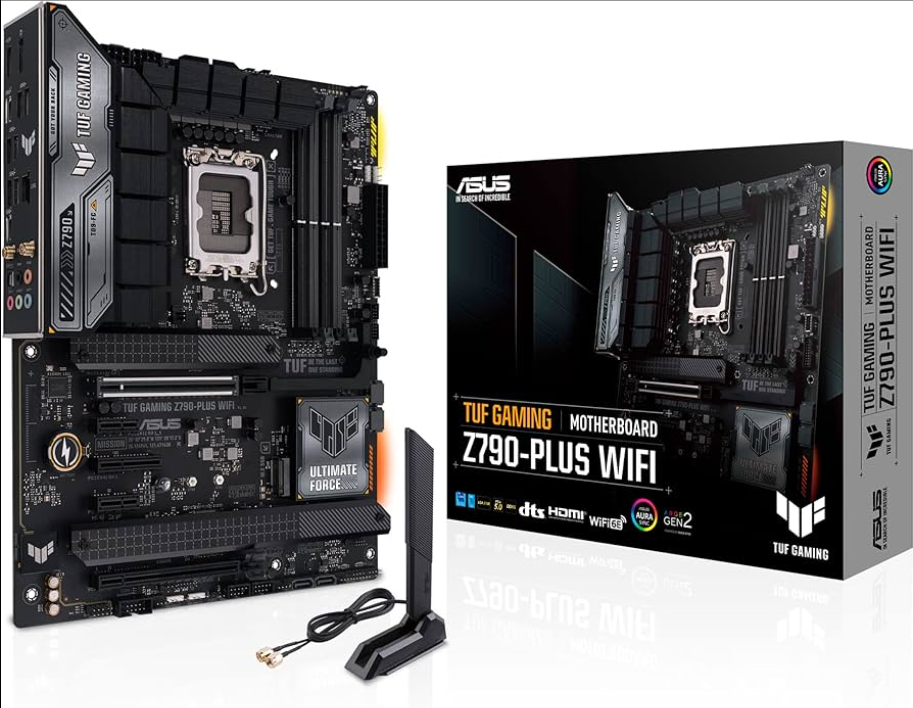
-
Daisy Chain – Optimized for 2-DIMM, high-frequency overclocking
-
T-Topology – Better for 4-DIMM population but usually lower maximum frequency
At 6400MHz and above:
-
PCB layer count
-
Trace length matching
-
VRM quality
-
BIOS maturity
all play critical roles.
A memory kit stable at 7200MHz on a premium Z790 board may struggle on mid-range B-series boards.
This is why frequency claims without motherboard context are incomplete.
4. Timings vs Frequency: The Latency Reality
Higher frequency does not automatically mean lower real latency.
Memory latency (in nanoseconds) depends on both:
-
Frequency (MT/s)
-
CAS latency (CL timing)
Example (simplified calculation):
-
6000MT/s CL30
-
7200MT/s CL36
Despite higher frequency, actual latency differences can be marginal.
In real-world workloads such as:
-
Office multitasking
-
Kompilacja oprogramowania
-
Maszyny wirtualne
-
Tworzenie treści
latency stability and consistency often matter more than raw bandwidth.
For many enterprise or OEM deployments, the optimal balance lies around 5600–6400MT/s with tighter timings rather than extreme frequency.
5. Long-Term Operation and Bit Error Rate (BER)
High-frequency DDR5 introduces increased risk in long-duration environments:
-
Higher signal noise margins
-
Greater voltage sensitivity
-
Thermal accumulation
-
Sustained load degradation
While DDR5 includes on-die ECC, it corrects internal cell errors only. It does not replace full ECC DIMM functionality required in servers.
In continuous operation environments such as:
-
Industrial systems
-
Węzły obliczeniowe brzegowe
-
Long-running workstations
-
24/7 office systems
marginal stability at high frequency may manifest as:
-
Random application crashes
-
Silent computation errors
-
Rare but critical data corruption events
These issues may not appear in short benchmarking sessions but emerge over months of continuous runtime.
This is where the true stability boundary exists.
6. Defining the Practical Stability Boundary
From a system perspective, the DDR5 stability boundary depends on:
-
CPU IMC quality and official support range
-
Motherboard topology and BIOS maturity
-
Thermal conditions and airflow design
-
Voltage tolerance margin
-
Long-duration workload pattern
For many large-scale deployments, frequencies beyond 6400MHz should be evaluated carefully rather than assumed beneficial.
In controlled enthusiast environments, extreme frequency may be viable.
In OEM and B2B environments, consistency across hundreds or thousands of units becomes the priority.
7. Stability Before Headline Frequency – Oreton’s Approach
Przy Oreton, our DDR5 strategy focuses on validated compatibility rather than theoretical maximum frequency.
For high-frequency DDR5 modules (including 6400MHz and above), we emphasize:
- Platform validation across mainstream Intel and AMD motherboards
-
IMC tolerance verification
-
Kontrola spójności na poziomie partii
-
Extended stress testing before shipment
-
Controlled voltage profiles to reduce long-term degradation risk
We believe high frequency has value — but only when it is sustainable.
In memory selection, matching the platform matters more than chasing peak numbers.
If you are evaluating DDR5 6400MHz+ modules for OEM deployment, our team can assist in analyzing motherboard, CPU, and workload combinations to define a realistic and stable configuration.
Because in long-term systems,
stability defines performance.