





For OEMs, PC system builders and hardware distributors, selecting an NVMe SSD is not simply about finding a model with high sequential read and write speeds. An SSD may perform well in a benchmark, but once it is integrated into a complete PC system, many other factors can influence its actual performance and reliability.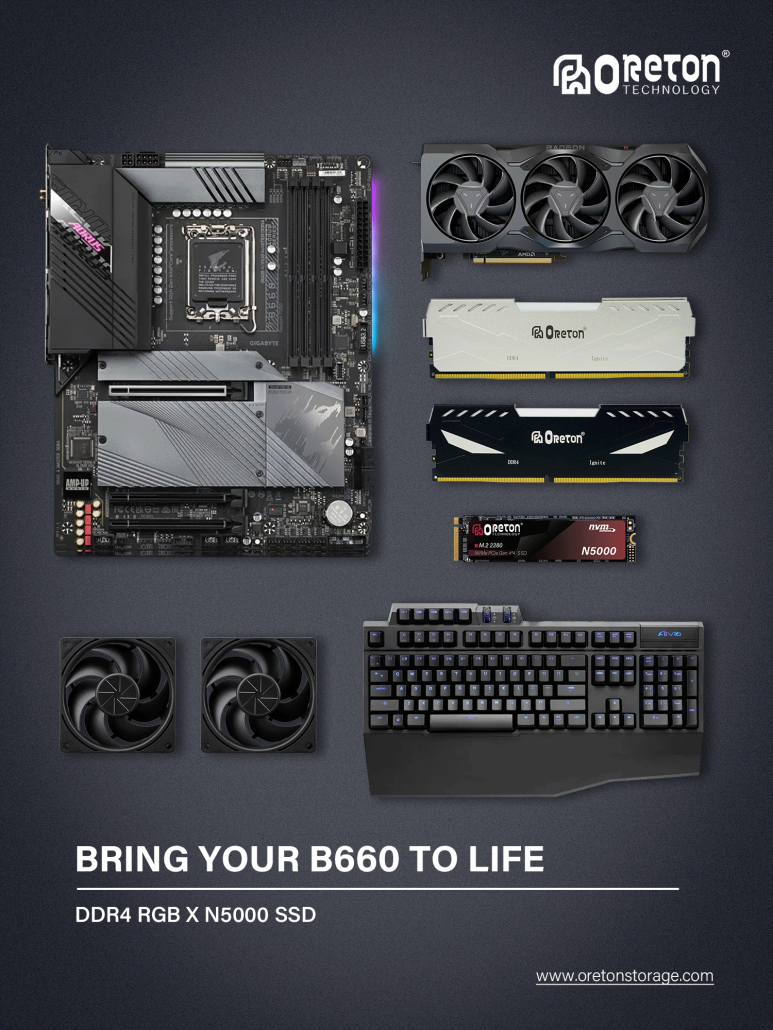
The CPU, motherboard, BIOS, thermal environment, firmware, NAND Flash and controller all work together as part of the storage system. A product that performs well on one test platform may not necessarily deliver the same results across different PC configurations.
Daarom NVMe SSD product qualification is an important step before an SSD is introduced into an OEM or large-scale PC program.
For OEM buyers, the goal is not simply to confirm that an SSD meets its specification sheet. It is to determine whether the product can provide stable performance, reliable operation, platform compatibility and consistent quality throughout the production lifecycle.
SSD Qualification Starts with the Complete Product Architecture
An NVMe SSD is a combination of multiple components rather than a single device. The NAND Flash, controller and firmware form the core of the SSD architecture, while the PCB, thermal design and power management also influence the final product.
The controller is responsible for managing communication between the host system and NAND Flash. It also handles important functions such as error correction, wear leveling, garbage collection, SLC caching and power management. Different controller platforms can therefore produce different performance and power characteristics, even when similar NAND Flash is used.
NAND Flash selection is equally important. NAND type, density, generation and endurance can affect the SSD’s performance, capacity, cost and expected service life. For mainstream PC applications, for example, TLC and QLC NAND can offer different balances between cost, performance and endurance.
Firmware then determines how these hardware components operate together. Functions such as SLC cache management, error handling, thermal control, power states and NAND management can all influence the final user experience.
For this reason, SSD qualification should look at the complete architecture rather than evaluating NAND, controller or firmware individually.
Platform Compatibility Is Just as Important as Performance
A high-performance SSD still needs to work correctly with the system it is installed in.
For PC integration, qualification should cover the combination of:
SSD + CPU + Motherboard + BIOS + Operating System
Interface compatibility is the first step. This includes PCIe generation, PCIe lane configuration and physical form factor such as M.2 2280.
For example, a PCIe 4.0 x4 NVMe SSD can deliver its intended interface performance when paired with a suitable PCIe 4.0 platform. When installed in a PCIe 3.0 system, however, the SSD will be limited by the host interface.
The same principle applies to PCIe 5.0 products. Installing a PCIe 5.0 SSD into a PCIe 4.0 platform does not make the entire system operate at PCIe 5.0 speeds.
There can also be differences between CPU and motherboard combinations. The same SSD may perform differently depending on the platform’s PCIe implementation, BIOS configuration and power management.
For OEM and PC system builders, testing only one reference platform is therefore not enough. Qualification should ideally include the actual CPU and motherboard configurations intended for production.
BIOS compatibility should also be considered. BIOS updates can improve NVMe device recognition, PCIe behavior, memory and storage compatibility, power management and overall system stability.
Performance Testing Should Go Beyond Peak Read and Write
Sequential read and write speeds are usually the first numbers buyers see on an SSD specification sheet. They are useful, but they do not tell the whole story.
A complete performance evaluation should also consider random read/write performance, IOPS, latency and sustained performance.
Sequential workloads involve large blocks of continuously transferred data, while random workloads involve smaller and less predictable data requests. Both can occur in normal PC usage.
For example, operating systems, applications and multitasking workloads can generate large numbers of small data requests. This makes random performance and latency relevant when evaluating overall system responsiveness.
Another important consideration is SLC cache gedrag.
Many consumer NVMe SSDs use an SLC cache to improve short-term write performance. During a relatively short benchmark, an SSD may achieve a very high write speed. However, once the available cache is heavily consumed, write performance can decrease.
This creates an important difference between:
Peak Write Performance
en
Sustained Write Performance
For OEM buyers, especially those building systems for gaming, content creation or other storage-intensive applications, longer-duration testing can provide a much better picture of how an SSD behaves in real workloads.
Testing conditions should also be standardized. The same SSD can produce different results depending on the test platform, firmware, drive capacity, drive fill level, temperature and benchmark settings.
Therefore, meaningful qualification requires consistent test conditions and repeatable testing methods.
Thermal and Reliability Validation
Performance cannot be separated from thermal behavior.
As NVMe SSD performance increases, the controller can generate more heat during intensive workloads. If the temperature reaches a certain level, the SSD may reduce performance to control its operating temperature. This behavior is commonly known as thermische smoring.
During qualification, it is useful to monitor:
- Idle temperature
- Typical workload temperature
- Peak temperature
- Performance changes over time
- Thermal throttling behavior
- Performance recovery after the workload
The actual PC environment also matters. An SSD installed underneath a motherboard heatsink can behave differently from the same SSD operating without additional cooling.
Power consumption should also be considered, particularly for laptops, compact PCs and systems with limited thermal or power budgets. Idle power, active read/write power and low-power-state behavior can all contribute to the overall system design.
Reliability testing should go beyond temperature and power. SSD health and endurance indicators such as TBW, NAND endurance, SMART information, Percentage Used, Media and Data Integrity Errors and Unsafe Shutdowns can provide additional information during validation.
No single value, however, can fully describe SSD reliability. Long-duration workloads, error handling and real operating conditions should also be included.
Sample Qualification Does Not End with One Approved Unit
One of the most important points for OEM procurement is that a successful sample test does not automatically mean that the product is ready for mass production.
A typical qualification process should move through several stages:
Engineering Sample → Platform Validation → Pilot Batch → Mass Production
During the sample stage, buyers can evaluate the SSD’s basic specifications, compatibility, performance and reliability.
However, testing multiple samples is important because different units can potentially show variations related to components, firmware or manufacturing conditions.
After the initial samples pass qualification, a pilot batch can provide a better indication of production consistency. The question changes from:
“Can this SSD achieve the required performance?”
to:
“Can the production process consistently deliver this performance?”
This distinction is particularly important for OEM customers ordering large quantities.
A properly controlled production process should include areas such as:
- NAND and controller verification
- PCB inspection
- Firmware verification
- Functional testing
- Capacity verification
- Performance sampling
- SMART and health-data verification
- Batch traceability
If a key component or firmware version changes during the product lifecycle, additional validation may also be required.
This type of change management and batch consistency is essential when an SSD is integrated into a large number of PC systems.
Qualification Should Match the Intended PC Application
Different PC applications place different demands on an SSD.
A gaming PC may prioritize fast random access, high performance, low latency and stable performance during large game installations or updates.
A mainstream desktop may place greater emphasis on capacity, compatibility, cost efficiency and reliable everyday performance.
A high-performance PC may require PCIe 4.0 or PCIe 5.0, higher IOPS, stronger sustained write performance and more attention to thermal management.
This means there is no single SSD specification that is ideal for every PC system.
The better approach is to match:
SSD Architecture + Performance + Thermal Design + Platform + Workload
to the requirements of the final system.
For OEMs, this can also help avoid over-specifying products. Selecting the highest theoretical performance SSD is not always the most efficient solution if the target motherboard, CPU or workload cannot take advantage of that performance.
Oreton’s Approach to NVMe SSD Product Qualification
Op Oreton, we believe that an SSD should be evaluated as part of the complete PC system rather than simply as a storage component with a list of specifications.
Our NVMe SSD development and qualification approach considers the complete product architecture, including NAND Flash, controller, firmware, PCB design, thermal characteristics and platform compatibility.
From initial component selection to engineering samples, platform validation, performance testing, reliability evaluation and production quality control, each stage contributes to the final product.
Our qualification focus includes:
Component Selection
NAND Flash and controller selection based on the intended product positioning and performance requirements.
Platform compatibiliteit
Validation across relevant CPU, motherboard, BIOS and operating-system configurations.
Performance Validation
Sequential and random performance, IOPS, latency, SLC cache behavior and sustained write performance.
Thermal & Reliability Testing
Temperature behavior, thermal throttling, power consumption, endurance and health monitoring.
Production Consistency
Sample-to-sample testing, pilot-batch validation and mass-production quality control.
For OEMs and PC system builders, this approach helps reduce the gap between specification-sheet performance and actual system performance.
The objective is not simply to achieve a high benchmark number. It is to provide an NVMe SSD solution that can operate reliably, consistently and predictably across the intended PC platform and production lifecycle.
Conclusie
NVMe SSD product qualification is ultimately a system-level process.
A successful qualification should answer more than whether an SSD can reach its advertised sequential read and write speeds. It should also confirm whether the product is compatible with the target platform, maintains stable performance under realistic workloads, manages heat effectively, provides reliable long-term operation and remains consistent across production batches.
For OEM buyers, the qualification process can be summarized as:
Component Evaluation → Sample Testing → Platform Validation → Reliability Testing → Pilot Batch → Mass Production
This approach gives OEMs and PC system builders greater confidence when integrating SSDs into their systems.
A strong NVMe SSD is therefore not simply the product with the highest benchmark number. It is the product that combines performance, compatibility, reliability, consistency and dependable supplier support throughout the entire product lifecycle.