Inleiding
When purchasing memory modules, most users compare specifications such as capacity, frequency, latency, and memory type. While these specifications are important, they represent only the final performance of the product.

For system integrators, OEM customers, distributors, and enterprise buyers, a more important question is
How is a high-quality memory module actually manufactured?
A reliable DDR memory module is the result of a carefully managed manufacturing process that combines component selection, engineering design, precision assembly, validation testing, and quality control.
Every stage—from selecting DRAM ICs to programming SPD data and validating compatibility—contributes to the stability, compatibility, and long-term reliability of the final product.
Understanding this process helps buyers evaluate not only the memory itself, but also the capabilities of the manufacturer behind it.
Step 1: Selecting the Right DRAM ICs
Every memory module begins with its most important component—the DRAM Integrated Circuit (DRAM IC).
DRAM ICs are responsible for storing and transferring data, making them the foundation of every DDR memory module.
The global DRAM industry is primarily supplied by leading semiconductor manufacturers such as:
- Samsung
- SK hynix
- Micron
However, selecting DRAM ICs is not simply about choosing a well-known supplier.
Professional memory manufacturers evaluate multiple factors before integrating DRAM ICs into a product, including:
- Performance characteristics
- Frequency capability
- Voltage requirements
- Capacity density
- Long-term supply availability
- Platform compatibility
Different applications require different memory solutions.
Bijvoorbeeld:
- Gaming systems often prioritize high-frequency operation and low latency.
- Professional workstations require stable performance under sustained workloads.
- OEM projects focus on consistency, compatibility, and long-term product availability.
A professional manufacturer matches DRAM ICs to the intended application rather than relying solely on specifications.
Step 2: PCB Design – The Foundation of Signal Stability
Once the DRAM ICs are selected, the next critical component is the Printed Circuit Board (PCB).
Although the PCB may appear to be a simple board connecting memory chips together, it plays a significant role in memory performance.
A well-designed PCB helps ensure:
- Stable signal transmission
- Proper power distribution
- Reduced electrical interference
- Better high-frequency operation
- Long-term reliability
As memory frequencies continue to increase with DDR5 technology, PCB quality has become even more important.
Manufacturers carefully design PCB layouts to optimize signal integrity and maintain stable communication between the memory controller and DRAM ICs.
A high-performance memory module depends not only on quality components but also on the engineering behind the PCB itself.
Step 3: SMT Assembly – Precision Manufacturing Matters
After the PCB and DRAM ICs are prepared, production moves to Surface Mount Technology (SMT) assembly.
SMT is the process of accurately mounting electronic components onto the PCB using automated production equipment.
The typical process includes:
- Automatic solder paste printing
- High-speed component placement
- Reflow soldering
- Automated Optical Inspection (AOI)
During this stage, manufacturers verify that each DRAM IC is correctly positioned and soldered.
Even small assembly inconsistencies can affect:
- Electrical stability
- Long-term reliability
- Product lifespan
High-precision SMT production helps ensure that every memory module meets consistent manufacturing standards.
Step 4: SPD Programming – Giving the Memory Module Its Identity
After hardware assembly, each memory module requires SPD (Serial Presence Detect) programming.
SPD is a small memory chip that stores essential configuration information used by the motherboard during system startup.
This information typically includes:
- Memory capacity
- Frequentie
- Timing parameters
- Operating voltage
- Manufacturer information
For memory modules supporting technologies such as Intel® XMP or AMD EXPO™, optimized performance profiles are also programmed into the SPD.
Without accurate SPD programming, even properly assembled memory modules may not operate at their intended specifications.
Programming and verifying SPD data is therefore an essential step in memory manufacturing.
Step 5: Validation and Compatibility Testing
Manufacturing a memory module does not end after assembly.
Professional manufacturers perform extensive validation before products enter mass production.
Testing commonly includes:
Platform compatibiliteit
Memory modules are verified across multiple Intel and AMD platforms to ensure broad compatibility.
Frequency Verification
Manufacturers confirm that modules operate correctly at their rated frequencies and timings.
Stability Testing
Long-duration stress tests evaluate memory stability under continuous workloads.
Boot and Training Tests
Memory initialization is verified to ensure successful system startup across different motherboard platforms.
Reliability Testing
Additional testing may include:
- High-temperature operation
- Long-term continuous workloads
- Repeated power cycles
- Data integrity verification
These validation processes help identify potential issues before products reach customers.
Step 6: Final Quality Inspection and Packaging
Before shipment, memory modules undergo final quality inspection.
This stage may include:
- Visual inspection
- Functional testing
- Label verification
- Serial number assignment
- Packaging inspection
Professional manufacturers also maintain production records that connect finished products with manufacturing batches.
This traceability improves:
- Quality management
- Warranty support
- Batch consistency
- After-sales service
For distributors and OEM customers, production traceability provides additional confidence throughout the product lifecycle.
Beyond DRAM ICs: What Really Determines Memory Quality?
Many buyers ask which DRAM supplier is used inside a memory module.
While DRAM IC selection is certainly important, it is only one part of the overall equation.
The final quality of a memory module depends on the complete manufacturing process, including:
- DRAM IC selection
- PCB engineering
- SMT production quality
- SPD programming accuracy
- Platform compatibility testing
- Reliability validation
- Production quality control
Even memory modules built with similar DRAM ICs may deliver different real-world performance depending on how these elements are integrated.
For OEM customers and professional buyers, evaluating a memory manufacturer should therefore go beyond component brands and consider the manufacturer’s engineering capabilities, manufacturing standards, and quality management system.
Oreton’s Approach to Memory Module Manufacturing
At Oreton, memory module manufacturing is built around consistency, compatibility, and long-term reliability.
Our engineering team carefully evaluates DRAM ICs based on product positioning, platform compatibility, and performance requirements before integrating them into production.
Throughout the manufacturing process, Oreton applies strict control across every stage, including: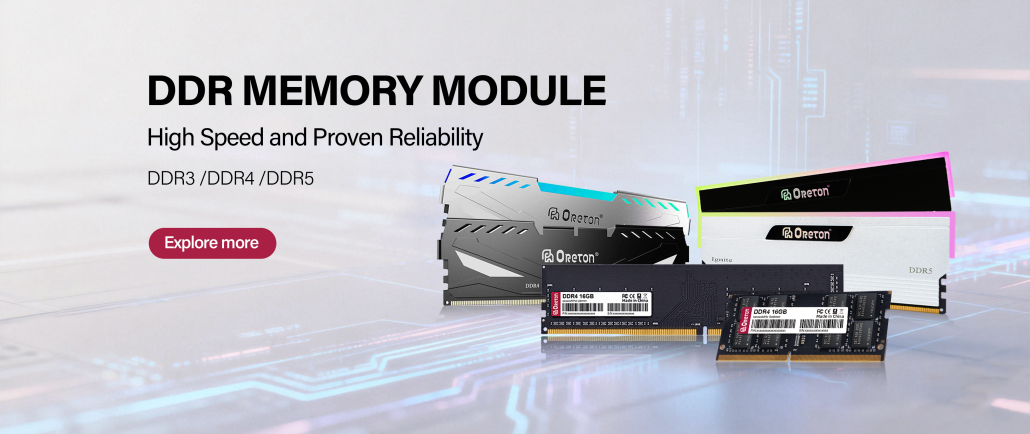
- DRAM IC evaluation
- PCB verification
- Precision SMT assembly
- SPD programming
- Platform compatibility validation
- Frequency and stability testing
- Final quality inspection
Rather than focusing only on specification sheets, Oreton emphasizes delivering memory solutions that perform consistently in real-world environments.
Our DDR4 and DDR5 memory products are designed to support a wide range of applications—from office PCs and gaming systems to professional workstations and OEM projects—providing dependable performance backed by disciplined manufacturing processes.
For global distributors, system integrators, and OEM partners, this commitment to manufacturing quality helps ensure product consistency, stable supply, and reliable long-term cooperation.
Conclusie
A high-quality memory module is the result of much more than assembling DRAM ICs onto a PCB.
From component selection and PCB engineering to SMT production, SPD programming, compatibility testing, and quality validation, every manufacturing stage contributes to the final performance and reliability of the product.
For businesses choosing a memory supplier, understanding how modules are manufactured provides valuable insight into the manufacturer’s engineering capabilities and commitment to quality.
At Oreton, we believe reliable memory begins with disciplined manufacturing, rigorous validation, and continuous quality improvement. By combining carefully selected components with comprehensive testing and process control, we deliver memory solutions that meet the demands of modern computing while supporting the long-term success of our global partners.