





As DDR5 memory continues to become more common across desktops, laptops, servers, and other computing platforms, the architecture of the memory module has also changed compared with previous generations.
One of the most noticeable changes is the introduction of a Energiebeheer-IC (PMIC) directly on the DDR5 memory module.
Unlike DDR4, where most of the memory power management is handled by the motherboard, DDR5 moves part of this function onto the DIMM itself.
So, what exactly does a DDR5 PMIC do? Why was it introduced, and how does it affect the way DDR5 memory is designed?
1. What Is a DDR5 PMIC?
PMIC stands for Power Management Integrated Circuit.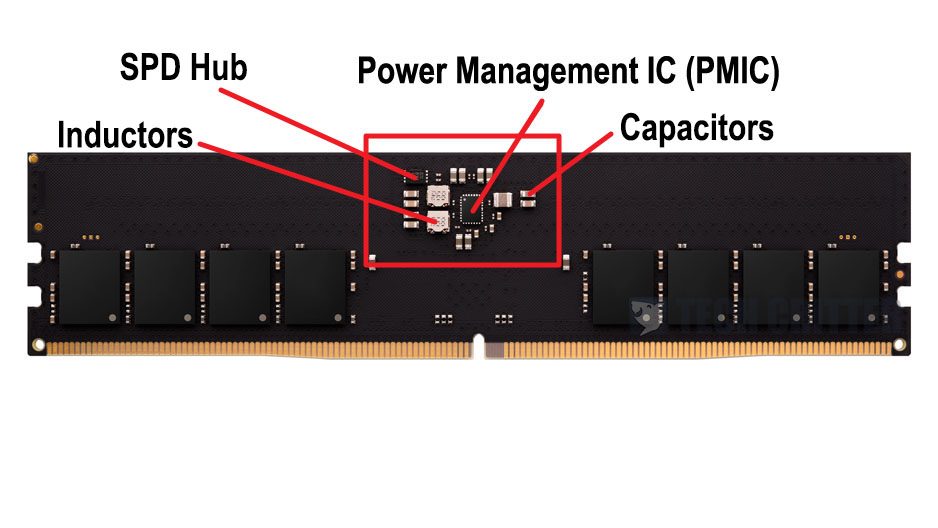
On a DDR5 memory module, the PMIC is responsible for managing and regulating the power supplied to the DRAM components on the DIMM.
In a simplified view, the power path can be understood as:
Motherboard Power → DDR5 PMIC → DRAM Components
Instead of relying entirely on the motherboard to provide the required power conditions for the memory chips, DDR5 places part of the power-management function closer to the DRAM devices.
This allows the memory module to perform local power conversion and regulation.
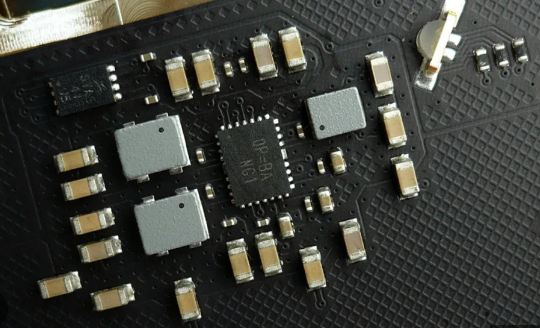
The PMIC is therefore not a memory chip itself. It is a power-management component that works alongside the DRAM ICs and other components on the memory module.
2. Why Does DDR5 Use a PMIC?
As memory technology evolves, memory speeds and densities increase.
Higher-speed memory requires increasingly careful control of power delivery and signal behavior. At the same time, modern memory modules may contain more DRAM capacity and operate under more demanding electrical conditions.
DDR5 addresses part of this challenge by moving power-management functions from the motherboard to the memory module.
This architecture provides a more localized approach to power delivery.
Instead of having the motherboard handle all of the voltage conversion and regulation before sending power to the DIMM, the DDR5 module can perform additional power management on the module itself.
This is one of the architectural differences that separates DDR5 from DDR4.
3. DDR4 vs. DDR5 Power Architecture
The power architecture of DDR4 and DDR5 is different.
With a typical DDR4 module, the motherboard provides the main DRAM supply voltage, while voltage regulation is largely handled on the motherboard side.
DDR5 changes this approach by incorporating a PMIC on the memory module.
A simplified comparison looks like this:
| Feature | DDR4 | DDR5 |
|---|---|---|
| Main power-management location | Primarily motherboard | Partly on DIMM |
| PMIC on standard DIMM | Generally no | Yes |
| Local power conversion | Limited on module | Performed by PMIC |
| Power architecture | Motherboard-centered | More module-level power management |
| Design consideration | Motherboard VRM and DIMM power delivery | Motherboard + PMIC + DRAM |
The purpose is not simply to make DDR5 “faster.”
Instead, the change is related to how power is delivered and managed as memory technology becomes more complex.
4. How Does a DDR5 PMIC Work?
The motherboard supplies power to the DDR5 module.
The PMIC then manages this incoming power and generates the appropriate supply rails required by the memory components.
A simplified process is:
Input Power → PMIC → Voltage Conversion and Regulation → DRAM
The PMIC helps provide controlled and stable power to the DRAM devices.
The exact implementation can vary depending on the DDR5 module design and PMIC used, but its general responsibilities include power conversion, voltage regulation, and management of multiple power rails.
This makes the PMIC an important part of the electrical architecture of a DDR5 DIMM.
5. DDR5 Uses Multiple Power Rails
A DDR5 memory module does not operate from one single voltage supply.
Different parts of the memory architecture require different power conditions.
The PMIC helps generate and manage multiple voltage rails used by the module.
For example, DDR5 DIMMs commonly involve supply rails associated with:
- DRAM core operation
- DRAM I/O
- Wordline and other internal memory functions
- Module-side components
The exact voltage values and implementation depend on the DDR5 specification, PMIC design, DRAM components, and module configuration.
The important point is that the PMIC allows these power requirements to be managed locally on the DIMM.
6. Why Local Power Management Matters
Moving power management onto the DIMM changes the relationship between the motherboard and memory module.
With more power-management functions located on the module, the DIMM can have greater control over how power is delivered to its DRAM components.
This can help reduce the dependency on long power-delivery paths between the motherboard voltage-regulation system and individual DRAM devices.
It also allows the memory module to be designed as a more self-contained electrical system.
For memory manufacturers, this means the PMIC becomes another important component that needs to be considered alongside the DRAM IC, PCB, and module layout.
7. PMIC and DDR5 Memory Stability
Stable power delivery is important for any DRAM system.
The DRAM chips need appropriate voltage levels to perform read, write, refresh, and other internal operations correctly.
If power delivery is not properly controlled, the memory system may experience electrical instability.
However, it is important not to assume that the PMIC alone determines whether a DDR5 module is stable.
Memory stability is influenced by multiple factors, including:
- DRAM IC characteristics
- PMIC behavior
- PCB design
- Memory controller
- Signal integrity
- BIOS and firmware
- Memory training
- Operating frequency and timings
- Operating temperature
- Motherboard design
The PMIC is therefore one part of a much larger memory system.
8. PMIC and DDR5 Thermal Design
Power conversion is not completely lossless.
When the PMIC converts and regulates electrical power, some energy is dissipated as heat.
As a result, the PMIC itself can become a heat source on the memory module.
This is one reason why DDR5 thermal design cannot focus only on the DRAM ICs.
The location of the PMIC, its power requirements, PCB layout, surrounding components, and heatsink design can all influence its thermal behavior.
For high-frequency DDR5 modules, thermal management may therefore need to consider both the DRAM components and the power-management section.
9. PMIC and the Overall DDR5 Module Architecture
A DDR5 DIMM is more than a collection of DRAM chips.
Its electrical and mechanical architecture can include:
DRAM IC + PMIC + SPD Hub + PCB + Heatsink
Each component has a different role.
The DRAM IC stores and accesses data.
The PMIC manages power delivery.
The SPD Hub provides access to module configuration and identification information.
The PCB connects these components and provides the electrical pathways between them.
The heatsink, when included, helps manage the thermal behavior of the module.
These components need to work together as a complete design.
10. Does a Better PMIC Automatically Mean Better Memory Performance?
Not necessarily.
The PMIC is important for power management, but it does not directly determine the advertised memory frequency or bandwidth.
For example, two DDR5 modules may use different PMIC solutions while having similar advertised specifications.
Their actual behavior can still depend on the DRAM IC, PCB design, memory controller, BIOS, timings, thermal conditions, and workload.
Likewise, simply changing the PMIC does not automatically turn a standard DDR5 module into a higher-performance product.
The PMIC should instead be viewed as one component that supports the electrical requirements of the overall memory design.
11. Why PMIC Selection Matters to Memory Manufacturers
For a memory manufacturer, selecting a PMIC is not simply a matter of choosing a component with the required voltage output.
The PMIC needs to work appropriately with the selected DRAM ICs and the rest of the module design.
Manufacturers may need to consider:
- DRAM IC selection
- Module capacity
- Memory frequency
- Power requirements
- PCB design
- PMIC specifications
- Thermal characteristics
- Platform compatibility
- Long-term supply
- Product consistency
A change in one component can affect the electrical and thermal behavior of the complete module.
This is particularly important when developing different DDR5 capacities or frequency versions.
12. DDR5 PMIC Is Part of a System-Level Design
One of the key ideas behind DDR5 power management is that the PMIC should not be considered as an isolated component.
A memory module is a complete electrical system.
Its performance and stability depend on how different components interact.
A simplified relationship can be expressed as:
DRAM IC + PMIC + PCB + Memory Controller + BIOS + Thermal Environment
The PMIC helps provide the power conditions required by the DRAM, while the other components and the platform determine how effectively the memory system operates as a whole.
This is why memory specifications such as capacity and frequency alone cannot fully describe the engineering characteristics of a DDR5 module.
13. What This Means for DDR5 Module Design
The introduction of the PMIC changes how memory manufacturers approach DDR5 module development.
Compared with DDR4, the module itself now contains an additional power-management component that needs to be selected, integrated, and validated.
This adds another layer to the design process.
For manufacturers, the focus is therefore not only on:
“Which DRAM IC should we use?”
but also:
“How should the DRAM IC, PMIC, PCB, thermal structure, and platform work together?”
This system-level approach becomes increasingly important as DDR5 modules move toward higher frequencies and larger capacities.
14. How Oreton Approaches DDR5 Memory Design
At Oreton, we view DDR5 memory as a complete module rather than simply a combination of DRAM chips and advertised specifications.
DRAM IC selection, PMIC, PCB design, module capacity, frequency, thermal structure, and platform compatibility all need to be considered together.
For OEM and customized memory projects, different applications may require different combinations of these components.
The goal is to achieve a practical balance between performance, compatibility, stability, thermal behavior, and product consistency.
Conclusie
The introduction of the PMIC is one of the important architectural changes in DDR5 memory.
Unlike DDR4, where power management is primarily handled on the motherboard, DDR5 places part of the power-management function directly on the DIMM.
The PMIC helps convert and regulate incoming power and provide the required supply rails for the DRAM components.
However, the PMIC is only one part of the overall memory architecture.
DRAM IC, PMIC, PCB, memory controller, BIOS, thermal conditions, and platform design all contribute to the final behavior of a DDR5 module.
Understanding this relationship is important not only for memory users, but also for manufacturers and OEM designers developing reliable DDR5 solutions.
In Part 2, we will go further into the relationship between DDR5 PMIC, temperature, memory stability, and platform compatibility, and look at what OEM designers should consider when evaluating DDR5 modules.