





Introduzione
SSD endurance is often represented by metrics such as TBW (Terabytes Written) or DWPD. However, the amount of data written by the host is not necessarily equal to the amount of data actually written to NAND Flash.
This difference is closely related to a key storage metric:
Write Amplification Factor (WAF).
Write amplification describes the relationship between the amount of data written by the host system and the amount of data ultimately written to NAND Flash.
A simplified representation is:
WAF = NAND Write / Host Write
For example, if a host writes 100 GB of data but the NAND receives 150 GB of actual writes, the write amplification factor is:
WAF = 1.5
A higher WAF means more NAND program/erase activity, which can increase wear and reduce available endurance.
For SSD manufacturers, understanding and controlling write amplification is therefore an important part of SSD performance, endurance, and firmware optimization.
What Causes Write Amplification?
Write amplification is mainly related to the way NAND Flash stores and manages data.
NAND Flash cannot simply overwrite existing data in the same way as traditional hard drives.
Instead, data is generally written to available pages, while outdated data remains until the corresponding blocks are erased.
This creates additional internal operations.
A typical process can look like:
Host Write
↓
Data stored in NAND
↓
Old data becomes invalid
↓
Garbage Collection
↓
Valid data moved
↓
Block Erase
↓
Block becomes available again
The additional movement of valid data is one of the major sources of write amplification.
NAND Flash Writes and Erase Operations
Understanding NAND endurance requires understanding the relationship between Program/Erase (P/E) cycles.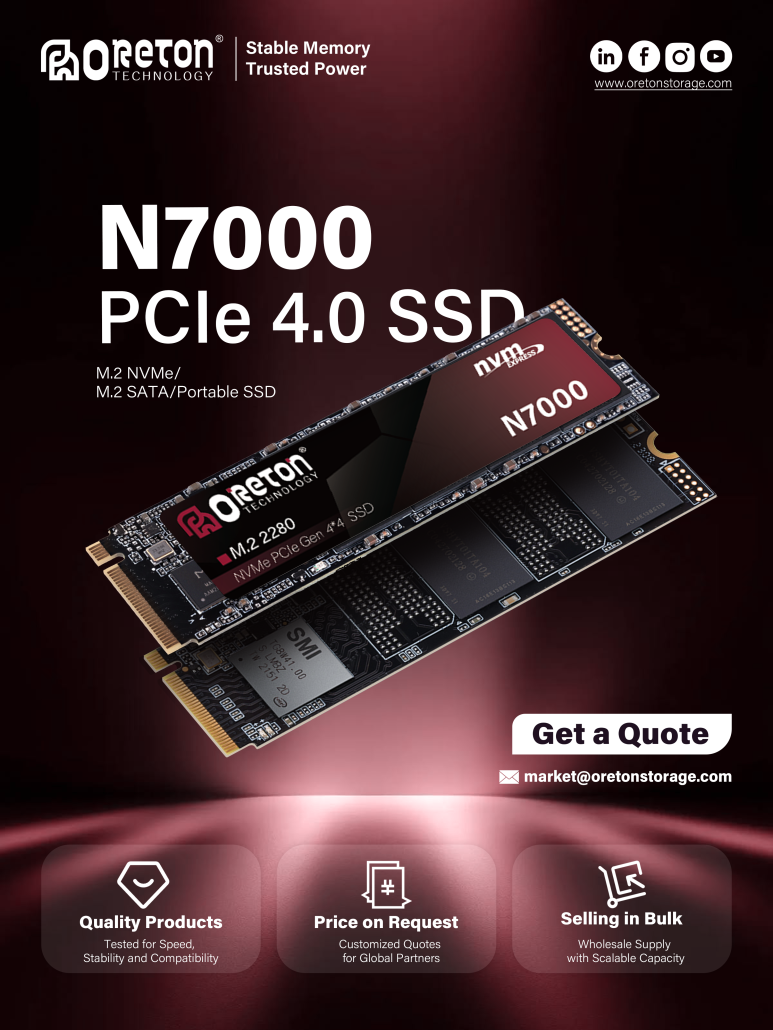
NAND Flash cells have a finite number of P/E cycles.
Every time data is programmed into a NAND page and the corresponding block is eventually erased, the NAND cells experience additional wear.
The exact endurance depends on the NAND technology and architecture.
Different NAND types can have different endurance characteristics:
- SLC
- MLC
- TLC
- QLC
As the number of bits stored per cell increases, storage density improves, but the electrical margins between states become more complex.
This makes NAND management increasingly important for SSD manufacturers.
Write Amplification and Garbage Collection
Garbage Collection (GC) is essential for maintaining SSD performance.
When an SSD contains blocks with a mixture of valid and invalid pages, the controller needs to consolidate valid data before erasing the block.
Ad esempio:
Block A

[Valid] [Invalid] [Valid] [Invalid]
The controller may need to move the valid pages to another location:
New Block

[Valid] [Valid] [Empty] [Empty]
The original block can then be erased and reused.
These additional data movements generate NAND writes that were not directly requested by the host.
This contributes to write amplification.
The Role of TRIM
TRIM helps SSDs understand which data blocks are no longer required by the operating system.
Without TRIM, the SSD may not know that certain logical blocks have become unused.
With TRIM, the controller can identify invalid or unnecessary data earlier.
This can improve:
- Garbage collection efficiency
- Write performance
- Available free space
- NAND management
Under suitable workloads, better information about unused data can help reduce unnecessary internal writes.
Over-Provisioning and Write Amplification
Over-Provisioning (OP) is another important factor.
An SSD does not necessarily expose all of its physical NAND capacity to the user.
Some NAND capacity can be reserved for internal operations such as:
- Garbage collection
- Livellamento dell'usura
- Gestione dei blocchi danneggiati
- Metadata
- Data movement
Additional available space gives the controller more flexibility when reorganizing data.
In many workloads, greater over-provisioning can help improve garbage collection efficiency and reduce write amplification.
This is particularly important in workloads involving frequent random writes.
Sequential vs Random Workloads
Workload characteristics have a significant impact on write amplification.
Sequential Writes
Sequential workloads generally allow the controller to write data in a more organized manner.
This can reduce unnecessary data movement.
Random Writes
Random workloads can create fragmented blocks containing a mixture of valid and invalid pages.
This may require more internal data movement during garbage collection.
As a result, random-write workloads can generate higher write amplification under certain conditions.
This is one reason why SSD performance and endurance cannot be evaluated using sequential benchmark results alone.
The Role of the SSD Controller
The SSD controller is responsible for managing much of the internal NAND behavior.
Its responsibilities can include:
- NAND Flash management
- Garbage Collection
- Wear Leveling
- ECC
- Bad Block Management
- SLC Cache Management
- Data Mapping
The controller determines how efficiently data is organized and moved within the NAND.
A well-designed controller and firmware combination can improve internal data management and help control unnecessary NAND writes.
Firmware Optimization Matters
Hardware alone does not determine write amplification.
Firmware algorithms play a major role.
SSD firmware manages:
- Logical-to-physical address mapping
- Garbage collection
- Livellamento dell'usura
- Cache behavior
- NAND allocation
- Background data movement
Poorly optimized firmware can cause excessive internal data movement.
Well-designed firmware can better coordinate these operations according to workload conditions.
This is particularly important when designing SSDs for different applications.
A consumer SSD, gaming SSD, industrial SSD, and enterprise SSD may face very different workloads and therefore require different optimization strategies.
Write Amplification and TBW
TBW is commonly used to describe SSD endurance.
However, TBW should not be interpreted simply as:
“The SSD can physically write exactly this amount of data.”
The actual NAND workload includes both:
L'autore scrive
e
Internal NAND Writes
Write amplification connects these two.
Ad esempio:
If a host writes:
1 TB
and the SSD generates a WAF of:
1.5
the NAND may receive approximately:
1.5 TB
of writes.
Therefore, controlling write amplification can help make more efficient use of NAND endurance.
Wear Leveling and Endurance
Write amplification is only one part of NAND endurance management.
Wear Leveling also plays an important role.
Without effective wear leveling, some NAND blocks could experience significantly more P/E cycles than others.
The controller can distribute data across NAND blocks to help balance wear.
The combination of:
- Wear Leveling
- Garbage Collection
- Over-Provisioning
- TRIM
- ECC
- Bad Block Management
creates a complete NAND management strategy.
Why NAND Selection Still Matters
Firmware optimization cannot completely compensate for inappropriate NAND selection.
Different NAND components can have different characteristics, including:
- Density
- Resistenza
- Prestazioni
- P/E cycle characteristics
- Interface speed
- Die configuration
For SSD manufacturers, the relationship between NAND Flash + Controller + Firmware must be evaluated as a complete system.
The same controller can behave differently depending on the NAND configuration and firmware implementation.
This is why NAND qualification is an important part of SSD product development.
Oreton’s Approach to SSD Endurance
At Oreton, SSD endurance is considered at the component and system levels.
Our SSD development process evaluates the interaction between:
Flash NAND
SSD Controller
Firmware
Gestione termica
Workload Characteristics
Rather than focusing only on peak sequential performance, SSD validation also considers sustained workloads, NAND behavior, thermal conditions, and long-term stability.
For products such as the Oreton N7000, careful matching of PCIe 4.0 NAND, controller, firmware, and thermal design helps balance high performance with reliable long-term operation.
For OEM and distribution customers, this approach provides a more complete understanding of SSD quality than benchmark speed alone.
Conclusione
Write amplification is one of the hidden factors behind SSD endurance.
The amount of data written by the host does not always equal the amount of data written to NAND Flash. Garbage collection, wear leveling, data movement, and other internal operations can generate additional NAND writes.
Managing these operations efficiently requires cooperation between:
NAND Flash + Controller + Firmware + Over-Provisioning + Workload Management
For SSD manufacturers, controlling write amplification is therefore not simply a performance optimization—it is an important part of NAND endurance and long-term product reliability.
A high-quality SSD is not defined only by how fast it can write data.
It is also defined by how efficiently it manages every write behind the scenes.