





When evaluating an SSD, specifications such as sequential read speed, sequential write speed, capacity, and interface are often the first things people look at. However, these specifications do not show everything happening inside the drive.
One important factor is Write Amplification (WA).
An SSD may receive a certain amount of data from the host system, but the NAND flash can end up writing more data internally. This difference is known as write amplification, and it can affect SSD performance, NAND endurance, thermal behavior, and long-term reliability.
Understanding write amplification is therefore important not only for SSD users, but also for manufacturers and OEM designers who need to balance performance, endurance, capacity, and consistency.
1. What Is SSD Write Amplification?
Write Amplification describes the relationship between the amount of data written by the host system and the amount of data actually written to NAND flash.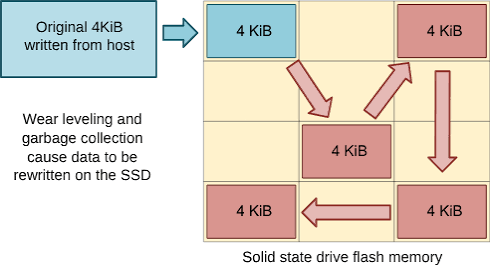
A simplified way to express it is:
Write Amplification = NAND Writes ÷ Host Writes
For example, if the host writes 100 GB of data but the NAND flash internally writes 150 GB, the write amplification factor would be 1.5.
Ideally, the amount of NAND data written would be as close as possible to the host-written data. However, because of the way NAND flash stores and manages data, internal operations can cause additional data movement and writing.
This is why an SSD can sometimes write more data internally than the host actually requested.
2. Host Writes vs. NAND Writes
To understand write amplification, it is important to distinguish between host writes et NAND writes.
Host writes are the amount of data sent to the SSD by the operating system or application.
For example, when a system saves a 10 GB video file, the SSD may receive approximately 10 GB of host writes.
NAND writes represent the data actually written to the NAND flash after the SSD controller performs its internal data management.
The controller may need to move existing valid data, reorganize blocks, manage free space, or perform other internal operations. As a result, the NAND may receive more write activity than the host requested.
This difference is one of the key reasons why SSD endurance cannot be evaluated simply by looking at how much data the host writes.
3. Why Does Write Amplification Happen?
The main reason is related to the structure of NAND flash.
NAND flash does not work like traditional hard disk storage. Data is written at the page level, while NAND blocks are generally erased at the block level.
When some data inside a block needs to be changed, the SSD cannot always simply overwrite the existing data in place.
Instead, the controller may need to:
- Write the updated data to a new location.
- Keep the valid data from the original block.
- Mark the old data as invalid.
- Move valid data when necessary.
- Erase the old block.
- Reuse the newly available block.
These additional operations can increase the amount of data written to NAND.
This internal data movement is a major source of write amplification.
4. The Role of Garbage Collection
Garbage Collection (GC) is another important factor.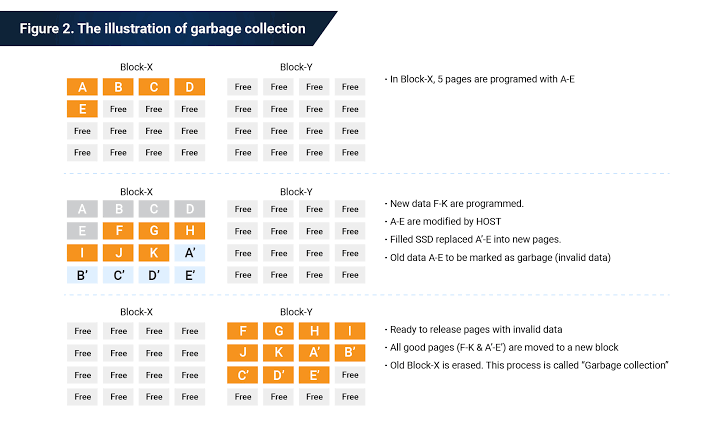
As an SSD is used, NAND blocks can contain a mixture of valid and invalid data. Invalid data no longer needs to be retained, but the block itself cannot necessarily be reused until it has been erased.
The SSD controller therefore identifies blocks containing invalid data, moves the remaining valid data to another location, and then erases the block so it can be reused.
This process helps maintain available NAND space, but moving valid data creates additional internal writes.
For example, imagine a NAND block containing several pages:
- Some pages contain valid data.
- Some pages contain data that has already been deleted or replaced.
The controller can reclaim the block by moving the valid pages elsewhere and erasing the entire block.
The host may not have requested those additional writes, but they are necessary for internal NAND management.
C'est pourquoi, Garbage Collection can contribute to Write Amplification.
This is also why Write Amplification should be considered together with other SSD management mechanisms rather than as an isolated specification.
5. How TRIM Can Affect Write Amplification
TRIM can also influence how efficiently an SSD manages invalid data.
When the operating system deletes a file, the SSD may not immediately know which physical NAND pages are no longer required. A TRIM command allows the host system to inform the SSD that certain logical blocks no longer contain useful data.
The controller can then identify these areas as invalid and manage them more efficiently during future garbage collection.
With better information about which data is no longer needed, the controller may reduce unnecessary data movement in some workloads.
However, TRIM does not eliminate write amplification completely.
Actual behavior depends on the SSD controller, firmware, NAND configuration, over-provisioning, workload, and system environment.
6. Free Space and Write Amplification
Available free space can also influence SSD internal operations.
When an SSD has sufficient free blocks available, the controller generally has more flexibility when managing incoming writes and reorganizing NAND data.
When the drive becomes heavily occupied, the controller may have fewer immediately available blocks and may need to perform more data movement before creating reusable space.
This can increase internal write activity in some workloads.
For this reason, SSD performance and behavior can change as the drive moves from a lightly used state toward a heavily used state.
The relationship is not simply:
More free space = lower Write Amplification
because actual behavior depends on the controller architecture, firmware, over-provisioning, NAND configuration, and workload.
However, available space is an important factor in SSD internal management and should be considered during performance and endurance testing.
7. Workload Has a Major Influence
Write Amplification is not a fixed value under every workload.
Different workloads can produce very different internal write behavior.
For example, large sequential writes are generally easier for an SSD controller to manage than frequent small random writes.
A workload involving many small updates may require the controller to move and reorganize existing data more frequently.
Consider two simplified scenarios.
Large Sequential Writes
A system continuously writes large files to the SSD.
The controller can often process these writes in a relatively organized way, potentially reducing unnecessary data movement.
Small Random Writes
A system frequently modifies small portions of data across different locations.
The controller may need to reorganize existing valid data more often, which can increase internal NAND writes.
Therefore, measuring Write Amplification under only one benchmark workload may not provide a complete picture.
For OEM applications, testing should reflect the actual expected workload.
8. Why Small Writes Can Be Challenging
Small write operations can be particularly important when evaluating SSD behavior.
NAND flash has specific page and block structures. When a workload modifies only a small amount of data, the controller may need to perform additional internal operations to manage the surrounding data efficiently.
In certain situations, this can involve moving valid data or performing read-modify-write operations.
The result is that a relatively small amount of host data can generate a larger amount of NAND activity.
This is one reason why random write workloads and mixed workloads can reveal SSD behavior that is not visible in a simple sequential write benchmark.
9. SLC Cache and Internal Write Activity
Many modern SSDs use an SLC cache to improve write performance.
In a simplified model, incoming data may first be written using a faster SLC-like mode before being reorganized into the final NAND storage format.
This can improve short-term write performance, especially during burst workloads.
However, additional internal data movement may occur when data is later reorganized or folded into the underlying NAND configuration.
As a result, the relationship between host writes and NAND writes can become more complex.
This does not mean that SLC caching is inherently inefficient. Instead, it highlights why SSD performance should be evaluated together with the controller, firmware, NAND configuration, cache behavior, and workload.
10. Write Amplification and SSD Performance
Write Amplification is usually discussed in relation to NAND endurance, but it can also influence performance.
When the controller needs to move valid data or perform garbage collection, SSD resources are being used for internal operations instead of directly processing new host writes.
Under light workloads, this may have little visible effect.
Under sustained or heavy workloads, however, internal operations can compete with host I/O and contribute to changes in write performance.
This is one reason why an SSD that delivers high peak write speed in a short benchmark may behave differently during long-duration workloads.
For SSD evaluation, it is therefore useful to consider both:
- Peak write performance
- Sustained write behavior
These two measurements describe different aspects of SSD behavior.
11. Write Amplification and NAND Endurance
One of the most important consequences of Write Amplification is its relationship with NAND endurance.
NAND flash has a finite number of program/erase cycles. Every additional internal NAND write contributes to NAND wear.
If the host writes 1 TB of data but the NAND internally writes 1.5 TB, the NAND has experienced more write activity than the host workload alone would suggest.
Over a long period, higher internal write activity can increase NAND wear.
This is why SSD endurance should not be considered only from the perspective of host-written data.
The actual NAND workload also matters.
Part 2 of this series will look more closely at the relationship between Write Amplification and NAND Endurance, including how NAND type, workload, over-provisioning, controller design, and validation methods can affect long-term SSD behavior.
12. What Determines Write Amplification?
There is no single component responsible for Write Amplification.
It is influenced by the interaction between multiple parts of the SSD architecture.
Flash NAND
Different NAND architectures and configurations can behave differently under various workloads.
SSD Controller
The controller determines how incoming data is mapped, organized, moved, and managed inside the NAND.
Firmware
Firmware controls many internal processes, including garbage collection, wear leveling, mapping management, and data organization.
Over-Provisioning
Additional NAND capacity reserved for internal management can give the controller more space to work with and may help reduce internal write pressure under certain workloads.
Charge de travail
Sequential, random, mixed, burst, and sustained workloads can produce different levels of internal write activity.
Drive Utilization
The amount of data already stored on the SSD can also influence how much flexibility the controller has when managing free and valid blocks.
Therefore, Write Amplification should be viewed as a system-level behavior, rather than a characteristic of NAND alone.
13. Why Capacity Can Matter
Different SSD capacities may use different numbers of NAND packages, dies, or internal configurations.
As a result, two SSDs from the same product family may not behave exactly the same simply because they share the same controller and NAND technology.
For example, a 512 GB model and a 2 TB model may have different internal NAND configurations and different levels of parallelism or available spare area.
These differences can affect how the controller manages data and internal operations.
For OEM applications, it is therefore important to avoid assuming that the behavior of one capacity version automatically represents the entire product family.
Capacity-specific validation can provide a more accurate picture.
14. Measuring Write Amplification
Write Amplification can be evaluated by comparing host writes with NAND writes over a defined workload.
A simplified measurement process can include:
Step 1 — Record Host Writes
Measure the amount of data written by the host system.
Step 2 — Record NAND Writes
Monitor the corresponding NAND write activity using appropriate SSD diagnostic information or test methods.
Step 3 — Calculate the Ratio
Compare NAND writes with host writes.
Step 4 — Repeat Under Different Workloads
Test sequential writes, random writes, mixed workloads, and sustained workloads.
Step 5 — Compare Different Drive States
Testing can also be performed at different levels of drive utilization to understand how internal behavior changes as the SSD becomes more heavily used.
The objective is not simply to obtain one number, but to understand how the SSD behaves under realistic operating conditions.
15. Why Short Benchmarks Are Not Enough
A short benchmark can show peak performance, but it may not reveal how an SSD behaves after extended use.
During a short test, the SSD may have plenty of free blocks and may not need to perform significant background data management.
During a long workload, however, the controller may need to perform more garbage collection, wear leveling, data movement, and other internal operations.
This can change both internal write activity and sustained performance.
For this reason, SSD validation should consider:
- Short burst performance
- Sustained write performance
- Random write workloads
- Mixed read/write workloads
- Different drive utilization levels
- Temperature conditions
- Long-duration operation
This approach provides a more complete view of SSD behavior.
16. Write Amplification Is a Design Trade-Off
Reducing Write Amplification is generally desirable, but SSD design involves multiple trade-offs.
The controller needs to manage performance, NAND endurance, capacity utilization, garbage collection, wear leveling, latency, and power consumption at the same time.
For example, aggressive background management may help prepare free blocks but can also generate additional internal activity.
Similarly, keeping more spare area may provide the controller with more flexibility, but it also affects the usable capacity of the product.
Therefore, there is no single configuration that is optimal for every application.
The appropriate balance depends on the target workload and product requirements.
17. What Should OEM Designers Look At?
For OEM SSD projects, Write Amplification should be considered as part of the overall SSD architecture.
Important evaluation areas include:
NAND Configuration
Understand the NAND type, organization, capacity, and expected endurance characteristics.
Controller and Firmware
Evaluate how effectively the controller and firmware manage data movement and internal NAND operations.
Charge de travail
Use realistic workloads instead of relying only on synthetic peak-performance tests.
Drive Utilization
Test the SSD at different levels of used capacity.
Sustained Performance
Measure how performance changes during long-duration workloads.
Thermal Behavior
Monitor temperature because sustained internal operations and heavy workloads can increase power consumption and heat generation.
Endurance
Evaluate how repeated workloads affect NAND wear over time.
These factors should be considered together rather than evaluated independently.
18. From Specification to SSD Architecture
Write Amplification is a good example of why SSD evaluation should go beyond the specifications printed on the product label.
Two SSDs may advertise the same capacity, interface, and sequential write speed, but their internal behavior can still differ.
The combination of NAND, controller, firmware, cache strategy, over-provisioning, thermal design, and workload determines how efficiently the SSD handles data internally.
For OEM projects, understanding these interactions can help manufacturers develop SSD solutions that are not only fast in short benchmarks, but also consistent and reliable under real-world workloads.
19. Oreton’s Approach to SSD Design and Validation
Au Oreton, SSD development focuses on the complete storage architecture rather than individual specifications.
Controller selection, NAND configuration, firmware behavior, capacity, thermal design, and target application all need to be considered together.
For OEM projects, different workloads and product requirements may require different SSD configurations. Therefore, validation should include not only peak performance, but also sustained workloads, compatibility, thermal behavior, stability, and long-term operating conditions.
This approach helps ensure that SSD solutions are matched to the actual requirements of the target application.
Conclusion
Write Amplification explains why an SSD can write more data to NAND than the host system actually sends to the drive.
It is influenced by NAND architecture, controller design, firmware, garbage collection, TRIM, SLC cache behavior, over-provisioning, drive utilization, and workload.
For users, understanding Write Amplification helps explain why SSD performance and endurance can change under different usage conditions.
For OEM designers, it highlights an even more important point: SSD performance and endurance are not determined by peak specifications alone.
The relationship between host writes, NAND writes, internal data movement, and long-term workload behavior should be part of the SSD evaluation and validation process.
In Part 2, we will go deeper into the relationship between Write Amplification and NAND Endurance, and examine what OEM designers should consider when balancing performance, endurance, capacity, and long-term reliability.