





As DDR5 frequencies move beyond 6400MHz into 6800MHz and 7200MHz territory, performance headlines often focus on bandwidth gains
But one critical question receives less attention:
What is the real power and thermal cost of high-frequency DDR5?
For OEM deployments and long-duration systems, power behavior is not just an efficiency issue — it directly impacts stability, longevity, and total system reliability.
1. Why Frequency Increases Power Consumption
Memory power consumption is influenced by:
-
Operating voltage (VDD/VDDQ)
-
Switching frequency
-
Signal integrity compensation
-
Integrated PMIC behavior
When frequency increases:
-
Switching activity increases
-
Voltage often needs to be raised for stability
-
The integrated memory controller (IMC) works harder
Dynamic power roughly scales with:
P ∝ C × V² × f
Where:
-
V = voltage
-
f = frequency
This means small voltage increases can disproportionately raise power consumption.
Por ejemplo:
-
DDR5-5600 typically runs near 1.1V
-
DDR5-6400+ XMP profiles often require 1.25V–1.4V
A voltage increase from 1.1V to 1.35V can significantly increase power draw due to the square relationship.
2. The Role of DDR5’s PMIC
Unlike DDR4, DDR5 integrates a PMIC (Power Management IC) directly on the module.

This improves voltage regulation granularity but also introduces:
-
Additional heat generation on the DIMM
-
Sensitivity to motherboard 5V supply quality
-
Greater thermal concentration near the PMIC zone
At high frequencies:
-
Voltage ripple tolerance narrows
-
Thermal hotspots increase
-
Sustained heavy workloads amplify these effects
In compact systems or dense workstation builds, this becomes more noticeable.
3. CPU IMC Power Behavior
High memory frequency also increases the workload on the CPU’s Integrated Memory Controller.
For modern desktop platforms:
-
Intel LGA1700 CPUs
-
AMD AM5 processors
Running DDR5 above official JEDEC specifications often requires:
-
Higher IMC voltage
-
Adjusted System Agent voltage (Intel)
-
Adjusted SOC voltage (AMD)
This increases:
-
CPU package power
-
Memory subsystem temperature
-
Long-term electrical stress
In 24/7 systems, sustained elevated IMC voltage may reduce long-term stability margins.
4. Thermal Impact in Real-World Systems
In short benchmarking sessions, high-frequency DDR5 may appear stable.
However, in continuous workloads such as:
-
Software compilation
-
Virtual machines
-
Rendering
-
Data processing
-
Edge computing nodes
thermal accumulation becomes critical.
Higher power draw leads to:
-
DIMM surface temperature increase
-
VRM area stress on motherboard
-
Reduced voltage headroom
In small form factor systems or limited airflow environments, this can gradually affect reliability.
5. Performance Gain vs Power Trade-Off
Bandwidth increases from 6000MT/s to 7200MT/s may reach 15–20% in synthetic benchmarks.
But in real-world workloads:
-
Office productivity
-
Development environments
-
Virtualization
-
Most enterprise applications
performance scaling is often marginal.
In many OEM deployments, DDR5 5600–6400 provides:
-
Better power efficiency
-
Lower thermal density
-
Higher compatibility rate
-
Improved long-term stability
This is where the practical balance often lies.
6. Defining the Practical Efficiency Boundary
The real question is not:
“How high can frequency go?”
But rather:
“At what point does additional frequency provide diminishing returns while increasing power and thermal risk?”
For large-scale deployments:
-
Stability consistency across batches
-
Predictable power envelope
-
Lower voltage stress
-
Controlled thermal profile
are often more important than extreme bandwidth.
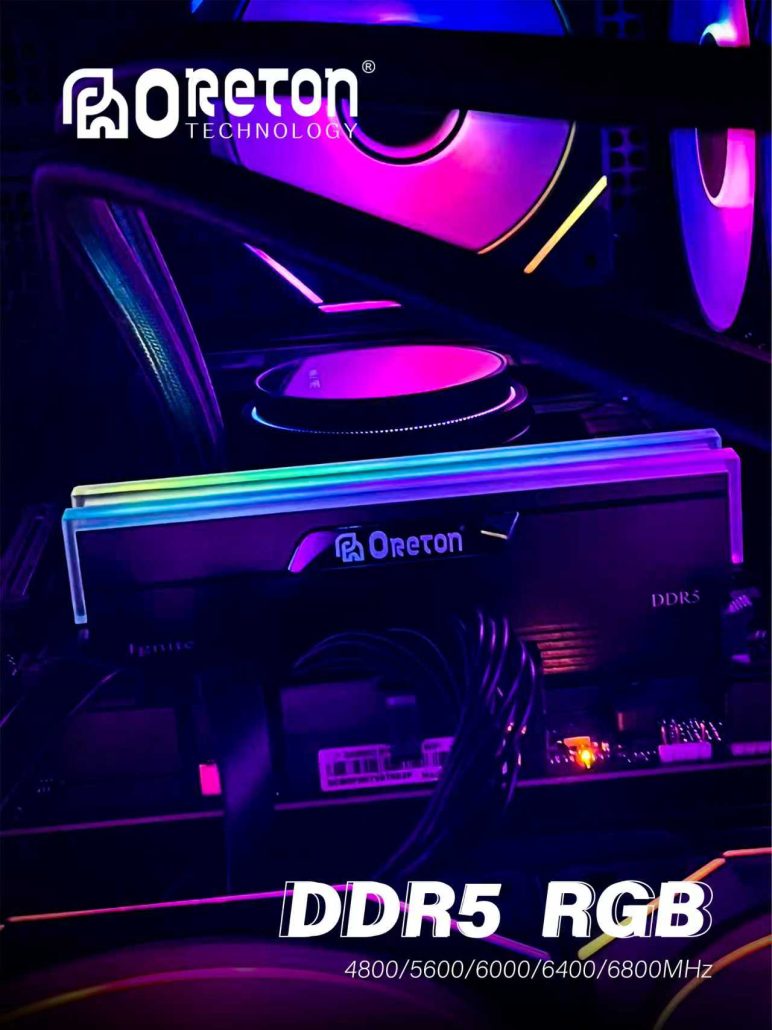
7. Oreton’s Perspective: Sustainable Performance Over Peak Numbers
En Oreton, we evaluate DDR5 high-frequency modules not only by bandwidth metrics, but by:
-
Voltage stability margins
-
Platform validation across Intel and AMD systems
-
Long-duration stress testing
-
Thermal behavior under sustained workloads
-
Batch-level consistency control
We believe performance should be sustainable — not situational.
In OEM environments, predictable power behavior defines long-term reliability.
If you are evaluating DDR5 6400MHz+ for deployment, our team can help assess frequency, voltage, and workload alignment to ensure stability without unnecessary power overhead.
Because in real systems,
efficiency is part of reliability.