





SSD specifications often highlight impressive sequential read and write speeds. A drive may advertise thousands of MB/s, and benchmark software can quickly produce numbers close to those figures.
However, peak benchmark performance does not always represent how an SSD behaves during a long-duration workload.
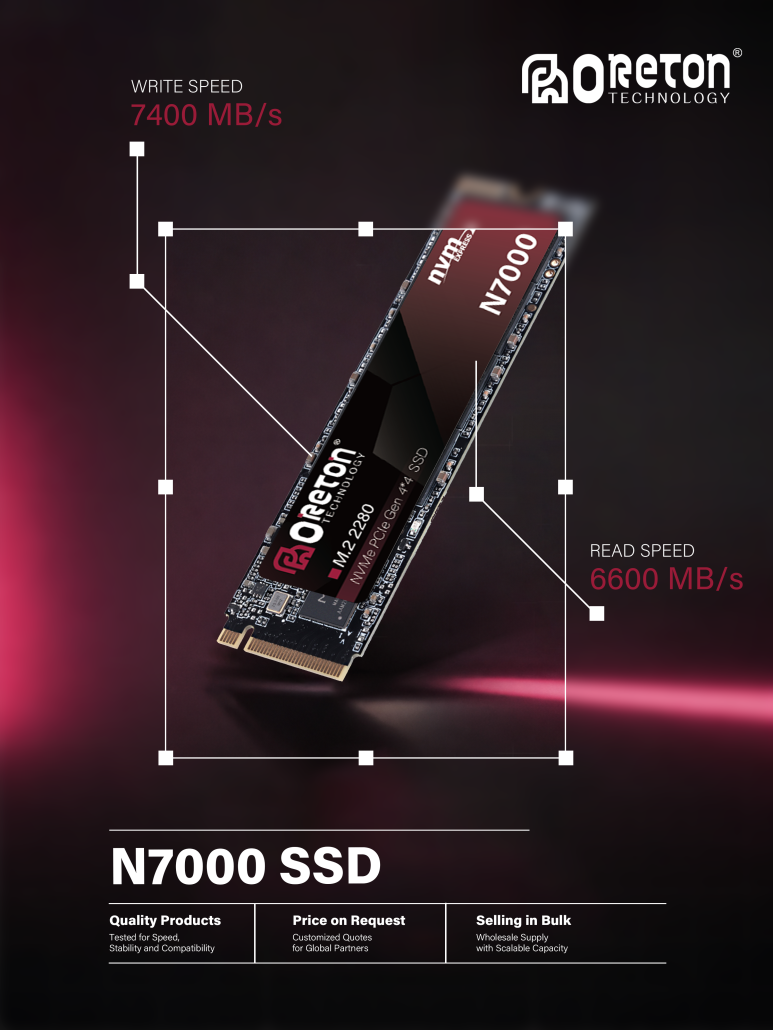
When a large amount of data is continuously written, the SSD may eventually move beyond its initial high-speed state. SLC cache capacity,
NAND characteristics, controller behavior, thermal conditions, and workload patterns can all influence sustained performance.
For applications such as large file transfers, video production, content creation, system imaging, data processing, and OEM systems with continuous storage activity, sustained performance can therefore be more meaningful than a short peak-speed result.
1. Peak Speed and Sustained Performance Are Different
Peak performance generally refers to the highest speed an SSD can achieve under specific test conditions.
Benchmark software often uses relatively short workloads, allowing the SSD to operate within an optimized performance window.
Sustained performance looks at what happens when the workload continues for a longer period.
For example, an SSD may initially write data at a very high speed. After several tens or hundreds of gigabytes of continuous writing, however, the write speed may decline.
This does not necessarily indicate a problem with the SSD.
It can be a normal result of how modern NAND-based storage systems manage cache, data, and thermal conditions.
The key difference is:
Peak Performance = Short-duration maximum performance
Sustained Performance = Performance maintained during extended workloads
Both measurements are useful, but they answer different questions.
2. SLC Cache Can Create a Large Difference
One of the most important factors behind SSD write behavior is the SLC cache.
Many modern SSDs use TLC or QLC NAND while temporarily operating part of the NAND as SLC cache. This allows incoming data to be written more quickly under suitable conditions.
During a short benchmark, the workload may fit largely within the available cache.
As a result, the SSD can show a high write speed.
But when the workload continues and the cache becomes full, the SSD needs to write data directly to the underlying NAND and may also need to move or reorganize data in the background.
The write speed can therefore decrease significantly.
A simplified example might look like this:
Initial Write → High SLC Cache Performance → Cache Fills → Lower Sustained Write Speed
This is why two SSDs with similar advertised sequential write speeds can behave differently during a long file transfer.
The important question is not only:
“How fast can the SSD write?”
It is also:
“How long can the SSD maintain that level of performance?”
3. NAND Characteristics Affect Sustained Performance
NAND Flash itself also plays an important role.
Different NAND configurations can have different characteristics in terms of performance, density, endurance, and write behavior.
TLC NAND, for example, stores three bits per cell, while QLC stores four bits per cell. The underlying NAND architecture and controller strategy can influence how data is written and managed.
The SSD controller must coordinate NAND operations, error correction, garbage collection, wear management, and other background processes.
As a result, sustained performance is determined by the interaction between the NAND and the controller rather than by NAND type alone.
This is also one reason why simply comparing TLC and QLC labels does not provide a complete picture of real-world SSD performance.
4. SSD Capacity Can Also Influence Write Performance
Capacity is another factor that is sometimes overlooked.
Different capacity versions of the same SSD family may not use exactly the same NAND configuration.
For example, a 1TB and 2TB version may have different numbers of NAND dies or different internal parallelism.
More NAND dies can allow the controller to access multiple NAND channels or dies simultaneously, potentially improving performance.
As a result, different capacity versions can show different performance characteristics even when they belong to the same product family.
This means that an SSD specification should be evaluated at the specific capacity level, rather than assuming that all capacities behave identically.
5. Thermal Conditions Can Reduce Sustained Performance
Temperature is another major factor during long-duration workloads.
High-speed SSD controllers and NAND devices generate heat, particularly during intensive read and write operations.
If the SSD reaches a thermal threshold, the controller may reduce its operating performance to control temperature. This behavior is commonly referred to as dławienie termiczne.
A typical performance pattern may therefore look like:
High Initial Performance → Temperature Rises → Thermal Limit Reached → Performance Reduced
Short benchmark tests may finish before thermal throttling becomes significant.
Longer workloads, however, provide a better opportunity to observe how the SSD behaves after its temperature increases.
This is particularly relevant for compact NVMe drives, laptops, mini PCs, and other systems with limited airflow.
6. Controller and Firmware Matter Too
The SSD controller acts as the central management layer between the host system and NAND Flash.
Its performance depends not only on processing capability but also on how it manages:
- NAND scheduling
- Error correction
- Zbieranie śmieci
- Niwelacja zużycia
- SLC cache
- Background data movement
- Zarządzanie energią
- Thermal behavior
Firmware controls many of these processes.
Two SSDs using similar NAND technology can therefore produce different real-world results because of differences in controller architecture and firmware optimization.
For this reason, sustained performance should be considered a system-level characteristic rather than a specification determined by one component.
7. Workload Size and Type Matter
Real-world workloads are rarely identical to benchmark workloads.
A short 10GB file transfer may produce very different results from a continuous 500GB write operation.
Similarly, sequential writing is different from random writing, and a mixed read/write workload creates another set of conditions.
Some common workloads include:
| Obciążenie pracą | What It Can Reveal |
|---|---|
| Short benchmark | Peak performance |
| Large file transfer | Zachowanie pamięci podręcznej SLC |
| Long-duration write | Zrównoważona wydajność |
| Random I/O | Controller and firmware behavior |
| Mixed read/write | Real-world system behavior |
| Repeated workloads | Thermal and consistency behavior |
This is why SSD testing should match the intended application.
A drive designed primarily for everyday office use may not need the same sustained-write characteristics as a drive intended for continuous data recording or professional content creation.
8. Why Peak Benchmark Results Can Be Misleading
Benchmark results are useful, but they need to be interpreted in context.
A single sequential write number may represent performance during a specific portion of the test rather than the entire workload.
For example, two SSDs might both advertise a sequential write speed of around 5,000 MB/s.
Under a short benchmark, their results may look very similar.
During a long continuous write, however, one drive may maintain a relatively stable performance level while the other may experience a significant drop after its cache is exhausted.
The difference becomes much more important when the workload involves large amounts of continuous data.
Therefore, a better SSD evaluation should look beyond:
Maximum Read Speed + Maximum Write Speed
and consider:
Peak Performance + Sustained Performance + Thermal Behavior + Workload Characteristics
9. Sustained Performance Testing for OEM SSD Projects
For OEM applications, sustained performance can be an important part of product qualification.
A proper validation process may include more than a short benchmark.
Depending on the application, testing can include:
Short-Duration Performance
Measures the SSD’s peak sequential and random performance under defined conditions.
Long-Duration Workloads
Uses extended read/write workloads to observe performance after the initial cache period.
Thermal Testing
Monitors temperature and performance changes during continuous operation.
Mixed Workloads
Combines different read and write patterns to better represent actual system usage.
Repeatability Testing
Repeats the workload under controlled conditions to evaluate performance consistency.
The purpose is not simply to find the highest benchmark score.
It is to understand how the SSD behaves throughout the workload that the final product is expected to handle.
10. Sustained Performance and SSD Quality
Sustained performance is also connected to overall SSD quality.
A well-designed SSD needs to balance several factors:
Performance + NAND Quality + Controller + Firmware + Thermal Design + Power Management
Optimizing only one factor can create limitations elsewhere.
For example, increasing peak performance without considering thermal conditions may result in stronger short-term benchmark results but less consistent long-duration performance.
Similarly, maximizing cache size can improve short-term write performance, but it does not necessarily guarantee the same performance after the cache is exhausted.
The goal should therefore be a balanced storage design that matches the intended workload.
11. A Better Way to Evaluate SSD Performance
When evaluating an SSD, consider asking several questions instead of looking at a single benchmark number:
- What is the peak sequential read/write performance?
- How does performance change during a long continuous workload?
- How large is the effective SLC cache under the test conditions?
- What happens after the cache is exhausted?
- How does temperature change during sustained operation?
- Does thermal throttling occur?
- What NAND and controller configuration is being used?
- Are different capacity versions configured differently?
- How consistent is performance across repeated tests?
- Does the test workload represent the target application?
These questions provide a more complete understanding of SSD behavior.
For OEM customers, this approach is particularly useful because the best SSD is not necessarily the one with the highest number on a specification sheet.
It is the one whose performance characteristics match the requirements of the final system.
12. Oreton’s Approach to SSD Performance
At Oreton, SSD performance is evaluated as part of the complete storage design rather than through a single peak-speed figure.
NAND Flash, controller selection, firmware, cache behavior, thermal conditions, and product configuration all need to work together.
For different applications, the appropriate performance target can also be different. Some products may prioritize peak performance, while others require stable sustained performance during extended workloads.
For OEM projects, performance validation can therefore be aligned with the target system and application rather than relying solely on standard benchmark results.
This approach helps balance performance, stability, compatibility, thermal behavior, and product consistency throughout the product development and production process.
13. Peak Speed Is Only One Part of SSD Performance
Peak benchmark performance remains useful because it provides a standardized way to compare SSD capabilities.
But it should not be treated as the complete picture.
During long-duration workloads, SLC cache behavior, NAND characteristics, controller and firmware design, capacity configuration, and thermal conditions can all influence the actual performance delivered by an SSD.
For users and OEM customers, the key is to evaluate the SSD under conditions that reflect its intended application.
Peak speed shows what an SSD can achieve. Sustained performance shows how it behaves when the workload continues.
For storage products designed for real-world use, both are important.