





소개
For SSD buyers, distributors, and OEM customers, choosing a storage supplier involves much more than comparing advertised speed.
Specifications such as: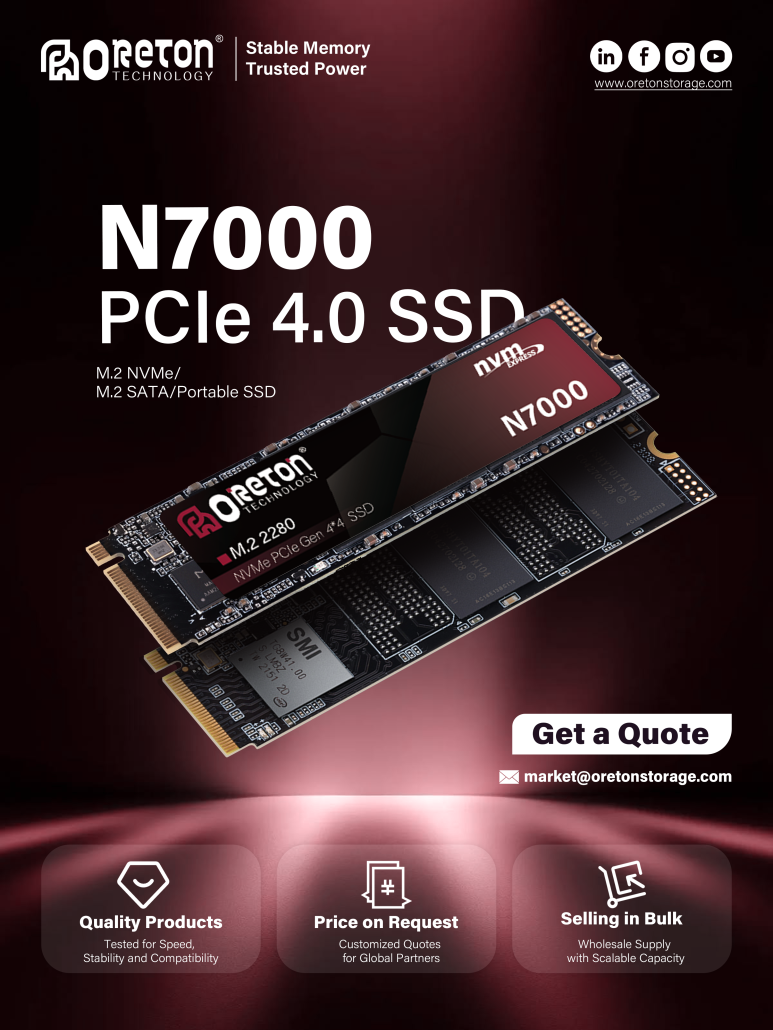
- 순차 읽기/쓰기 속도
- PCIe interface
- 용량
only represent the final product performance.
Behind every SSD is a more fundamental decision:
What NAND Flash memory is being used, and how is it integrated into the final design?
NAND Flash is the core storage medium inside an SSD, and its quality directly affects:
- Performance consistency
- 지구력
- 신뢰성
- Production stability
- Long-term product value
For professional SSD manufacturers, NAND selection is not simply purchasing memory chips.
It involves evaluating:
- NAND manufacturer
- Flash generation
- Original vs alternative components
- Part numbers
- Die configuration
- Density
- NAND grading
- Controller compatibility
- 펌웨어 최적화
Understanding these factors helps distributors and OEM customers make better decisions when selecting an SSD manufacturing partner.
NAND Flash Manufacturers: Why the Source of Memory Chips Matters
The NAND Flash market is mainly supplied by several global semiconductor manufacturers with advanced memory technologies.
Leading NAND suppliers include:
- 삼성
- Kioxia
- Western Digital
- 마이크론
- SK하이닉스
- Solidigm
These companies invest heavily in:
- NAND process technology
- 3D NAND architecture
- Memory density improvement
- Reliability optimization
However, simply using a well-known NAND brand does not automatically guarantee a high-quality SSD.
The final SSD performance depends on the complete combination of:
NAND + Controller + Firmware + PCB Design + Validation
A professional SSD manufacturer must understand how each NAND solution behaves with different controllers and workloads.
Original NAND vs Alternative NAND: What Should Buyers Understand?
One of the most common questions from SSD buyers is:
Does this SSD use original NAND?
In the SSD industry, NAND components can generally be categorized into different sourcing conditions.
Original NAND
Original NAND refers to memory chips supplied directly from recognized NAND manufacturers or authorized supply channels.
장점:
- Known specifications
- Better traceability
- More predictable performance
- Stable quality consistency
For brands, distributors, and OEM customers requiring long-term product reliability, component transparency is an important factor.
Alternative NAND Solutions
Some SSD products may use alternative NAND sources depending on:
- Market positioning
- Cost requirements
- Product category
This does not automatically mean poor quality.
However, manufacturers need stronger validation processes to ensure:
- 호환성
- Performance consistency
- 신뢰성
The key factor is not only where the NAND comes from, but whether the manufacturer has the engineering capability to properly evaluate and validate it.
Understanding NAND Part Numbers: The Information Behind the Chip
Professional buyers often request NAND part numbers because they provide deeper visibility into the actual components used inside an SSD.
A NAND part number can indicate information such as:
- Manufacturer identification
- NAND generation
- Technology type
- Density
- Package configuration
- Operating characteristics
For example, different NAND generations may have differences in:
- Cell architecture
- 성능 특성
- 지구력
- Power efficiency
Two SSDs may both advertise:
“1TB NVMe SSD”
but internally they may use completely different NAND configurations.
This can result in differences in:
- Sustained write speed
- Lifespan
- Temperature behavior
- Long-term stability
For professional customers, NAND part numbers provide an additional layer of product evaluation.
NAND Die Configuration: Why Internal Structure Affects Performance
Beyond the NAND manufacturer and model, SSD performance is also influenced by NAND architecture.
A NAND package may contain multiple Dies.
The relationship is:
NAND Package → Die → Memory Cells
The number of Dies affects:
- Parallel processing capability
- Controller workload distribution
- Performance scalability
예를 들어
A higher-density NAND configuration may reduce the number of packages required.
However, fewer NAND packages can sometimes reduce parallelism depending on the controller design.
Therefore, SSD manufacturers must balance:
- NAND density
- Number of packages
- Controller channels
- Target performance
A professional SSD design is not simply based on selecting the largest NAND capacity.
NAND Binning: Why the Same NAND Family Can Have Different Performance
Semiconductor manufacturing involves complex production processes.
After NAND production, memory components may go through:
- Electrical testing
- Performance evaluation
- Reliability verification
This process is commonly known as:
Binning
Different NAND components may have different characteristics based on:
- Performance capability
- Endurance characteristics
- 안정성
For SSD manufacturers, understanding NAND behavior is important when designing products for different markets.
예를 들어
A high-performance gaming SSD and an entry-level office SSD may require different NAND configurations.
The goal is not always selecting the highest specification component.
The goal is selecting the right component for the intended application.
TLC vs QLC NAND: Choosing the Right Technology for the Market
NAND technology selection is another important decision.
TLC 낸드
TLC stores three bits per cell.
장점:
- Better performance balance
- Higher endurance
- More suitable for sustained workloads
Common applications:
- Gaming SSD
- Professional storage
- High-performance consumer SSD
QLC NAND
QLC stores four bits per cell.
장점:
- Higher storage density
- Lower cost per capacity
Considerations:
- Lower native write performance
- Greater dependence on cache management
Suitable applications may include:
- Large-capacity storage
- Cost-focused products
For manufacturers, selecting TLC or QLC depends on:
- Target users
- Performance requirements
- Price positioning
Why NAND and Controller Compatibility Determines Final Performance
Even high-quality NAND cannot work independently.
The SSD controller must communicate efficiently with NAND Flash.
The controller manages:
- Data writing
- Error correction
- NAND scheduling
- 웨어 레벨링
- Garbage collection
Different NAND generations may require different controller optimization.
Therefore, professional SSD manufacturers need experience in:
- NAND qualification
- 펌웨어 튜닝
- Performance validation
A good NAND component with poor controller matching may not achieve expected results.
How Professional SSD Manufacturers Evaluate NAND Quality
Before mass production, manufacturers typically evaluate NAND through multiple stages:
Component Verification
Checking:
- NAND specifications
- Supplier information
- Part number consistency
Compatibility Testing
Testing NAND with:
- SSD controller
- Firmware
- PCB design
Performance Validation
Evaluating:
- Sequential performance
- 랜덤 성능
- Sustained write performance
Reliability Testing
Including:
- Temperature testing
- 장기간 지속되는 워크로드
- Data integrity verification
These processes separate professional SSD manufacturers from simple product assembly suppliers.
Oreton’s Approach to NAND Selection and SSD Manufacturing
At Oreton, SSD development focuses on building reliable storage solutions through careful component evaluation and system-level optimization.
For SSD products such as the Oreton N7000 PCIe Gen4 NVMe SSD, component selection involves evaluating:
- NAND Flash characteristics
- Controller compatibility
- 펌웨어 최적화
- 열 성능
- Real-world workload behavior
Rather than focusing only on peak benchmark numbers, Oreton emphasizes:
- Component consistency
- Stable performance
- Reliable production quality
For global distributors, system integrators, and OEM partners, transparent component selection and strong validation capability are essential when building long-term storage products.
Choosing an SSD Supplier: NAND Capability Matters
When evaluating an SSD manufacturer, buyers should consider more than product specifications.
Important questions include:
- What NAND suppliers does the manufacturer work with?
- Can they provide component information?
- How do they validate NAND compatibility?
- How do they maintain batch consistency?
- Do they have experience matching NAND with controllers?
A reliable SSD supplier should have the ability to control the entire process:
NAND Selection → Component Matching → Firmware Optimization → Testing → Mass Production