





As DDR5 memory becomes the new standard for modern computing platforms, many discussions focus on higher frequencies, larger capacities, and improved bandwidth. However, one of the most important architectural changes in DDR5 lies not in speed, but in power management.
Unlike DDR4 memory, DDR5 modules integrate a Power Management Integrated Circuit (PMIC) directly on the module. This design change fundamentally alters how memory receives and regulates power, influencing system stability, signal integrity, and efficiency.
Understanding why DDR5 introduced PMIC helps explain not only how the technology works, but also how modern memory platforms are evolving to support higher performance demands.
DDR4 vs DDR5: A Shift in Power Architecture
In DDR4 systems, power regulation for memory modules is primarily handled by the motherboard’s voltage regulator modules (VRMs). The motherboard supplies stable voltage to the DIMM slots, and the memory modules themselves rely on that external regulation.
This architecture worked well for DDR4, where frequencies typically ranged from 2133 MT/s to around 3200 MT/s in standard configurations. At these speeds, the motherboard could maintain adequate voltage stability across multiple DIMM slots.
However, as memory speeds increase, maintaining stable power delivery across the entire motherboard becomes more challenging. Signal integrity, voltage fluctuations, and electrical noise can all affect memory performance.
DDR5 addresses this challenge by shifting part of the power regulation responsibility from the motherboard to the memory module itself.
What the PMIC Does in DDR5 Memory
그리고 Power Management Integrated Circuit (PMIC) is responsible for converting and regulating incoming power directly on the DDR5 module.
Instead of the motherboard providing multiple regulated voltages, the motherboard now supplies a higher input voltage—typically around 5V—to the DIMM. The PMIC then locally converts this power into the specific voltages required by the memory components.
This localized regulation provides several advantages:
-
More precise voltage control
-
Reduced power noise
-
improved stability at higher frequencies
-
better scalability for future memory speeds
Because the regulation happens closer to the DRAM chips themselves, the system can maintain more stable power conditions even as memory bandwidth continues to increase.
Supporting Higher Frequencies and Larger Capacities
DDR5 introduces significantly higher bandwidth compared with DDR4. Standard DDR5 memory begins at 4800 MT/s, with many modules operating at 5600 MT/s, 6400 MT/s, or higher depending on the platform.
As frequency increases, memory becomes more sensitive to voltage fluctuations and signal noise. Even small variations can affect stability, especially in high-density modules or multi-DIMM configurations.
By integrating PMIC on the module, DDR5 can maintain tighter voltage control and faster power response, helping support higher operating frequencies and improved signal integrity.
This change also prepares the memory ecosystem for future scaling, as DDR5 specifications are expected to continue increasing in speed over time.
Impact on System Stability
The addition of PMIC can improve memory stability in several ways.
First, localized power management reduces the distance that regulated power must travel across the motherboard. This helps minimize electrical noise and voltage drop.
Second, the PMIC enables more consistent voltage regulation across different DIMM slots, which is particularly important in systems using multiple memory modules.
Third, DDR5 also introduces additional architectural improvements, such as dual 32-bit channels per DIMM, which work together with the improved power management design to enhance efficiency and data handling.
While PMIC does not eliminate all compatibility challenges—especially in very high-frequency memory configurations—it provides a stronger foundation for stable operation compared with the DDR4 power architecture.
A New Layer of Design Complexity
Although PMIC improves power management, it also introduces new design considerations.
Memory module manufacturers must carefully select and configure the PMIC to ensure reliable voltage conversion and thermal performance. Power regulation components generate heat, and the design of the module must account for this additional thermal load.
For system builders and OEM manufacturers, this means that module quality and validation processes become even more important, particularly when deploying systems at scale.
Reliable DDR5 modules require not only quality DRAM chips but also well-designed power management circuitry.
The Role of Validation and Component Control
Because DDR5 modules integrate more functionality than previous generations, manufacturers must implement thorough testing and validation procedures.
주요 요소는 다음과 같습니다:
-
PMIC configuration and reliability
-
DRAM chip compatibility
-
PCB layout and signal routing
-
thermal behavior under sustained workloads
Careful component selection and stability testing help ensure that memory modules maintain consistent performance across different platforms and long-term operation scenarios.
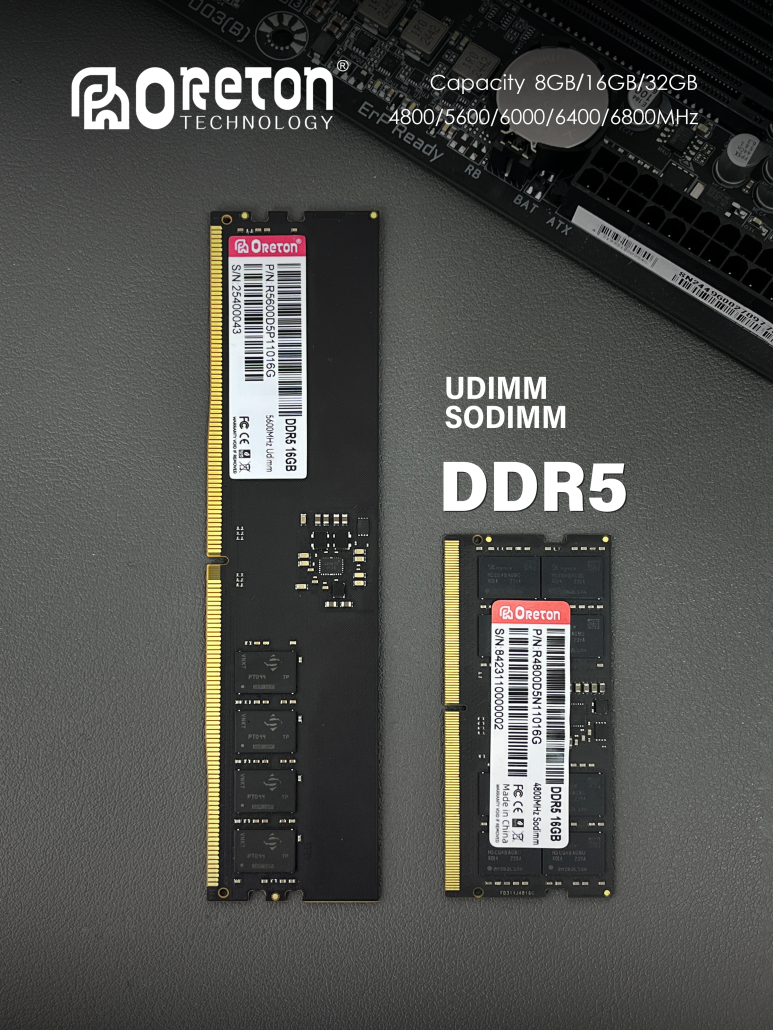
Oreton: Stable DDR5 Memory for Reliable Systems
At Oreton, DDR5 memory modules are developed with a focus on stability, compatibility, and consistent performance across platforms.
By combining carefully selected DRAM components with validated module designs, Oreton memory solutions are built to operate reliably in a wide range of system environments. Each batch undergoes additional internal inspection procedures before shipment, helping ensure stable operation and extremely low return rates in real-world deployments.
For partners seeking dependable memory solutions, the goal is not simply higher frequency specifications—but balanced performance supported by stable power management and consistent manufacturing quality.