





Building the Right SSD Product Mix for Different Market Segments
For SSD distributors, having the latest product is not necessarily the same as having the right product portfolio.
A successful distribution strategy requires more than offering a single high-performance NVMe SSD.
Different customers have different requirements for:
- Performance
- Capacité
- Price
- Interface
- Endurance
- Compatibilité
- Application
A distributor serving PC builders, system integrators, gaming customers and general consumer markets may therefore need a product portfolio covering SATA, PCIe 3.0, PCIe 4.0 and PCIe 5.0 SSDs.
The objective is not to replace every product with the newest generation.
It is to create a clear product ladder that matches different customer requirements and price points.
1. SSD Portfolio Should Be Built Around Market Segments
A common mistake in SSD distribution is focusing too heavily on one specification.
For example, a distributor may concentrate on PCIe 4.0 because it currently offers an attractive balance between performance and cost.
However, customers may still require:
- SATA SSDs for older systems
- PCIe 3.0 SSDs for mainstream upgrades
- PCIe 4.0 SSDs for gaming PCs
- PCIe 5.0 SSDs for high-performance platforms
Each segment serves a different purpose.
A well-designed portfolio should therefore cover multiple performance levels rather than competing only on maximum sequential speed.
2. SATA SSD: Entry-Level and Upgrade Markets
SATA SSDs remain relevant for specific applications.
Although NVMe technology offers substantially higher bandwidth, SATA SSDs can still be attractive for:
- Older desktops
- Older laptops
- PC de bureau
- System upgrades
- Entry-level computers
- Industrial applications
- Systems without M.2 NVMe support
For distributors, SATA products can provide an affordable entry point for customers upgrading from HDDs.
Typical capacities can include:
240GB / 480GB / 1TB / 2TB
The key advantage is not maximum performance.
C'est le cas :
Compatibility + Cost + Availability
3. PCIe 3.0 SSD: Mainstream Upgrade Segment
PCIe 3.0 NVMe SSDs occupy another important position.
They offer significantly higher bandwidth than SATA while maintaining compatibility with a wide range of existing PC platforms.
Typical applications include:
- PC de bureau
- Ordinateurs de bureau grand public
- Older gaming PCs
- Laptop upgrades
- Budget system builds
- General-purpose computing
For distributors, PCIe 3.0 can serve customers who want NVMe performance without paying for the latest generation.
This makes it useful as a value-oriented NVMe product line.
4. PCIe 4.0 SSD: The Mainstream Performance Segment
PCIe 4.0 has become one of the most important categories for modern PC builds.
Compared with PCIe 3.0, PCIe 4.0 provides significantly higher theoretical bandwidth.
This makes PCIe 4.0 suitable for:
- PC de jeu
- Ordinateurs de bureau performants
- Création de contenu
- Postes de travail
- High-performance laptops
- System integrators
For many distributors, PCIe 4.0 can serve as the core product line between entry-level SSDs and premium PCIe 5.0 products.
The advantage is a strong balance between:
Performance + Cost + Platform Availability
5. PCIe 5.0 SSD: High-Performance and Premium Systems
PCIe 5.0 represents the next performance tier.
With compatible platforms, PCIe 5.0 SSDs can deliver substantially higher sequential transfer rates than PCIe 4.0.
This makes them attractive for:
- Enthusiast gaming PCs
- High-end workstations
- Professional workloads
- New-generation platforms
- Performance-focused system integrators
However, PCIe 5.0 should not necessarily replace PCIe 4.0 across the entire product portfolio.
The higher performance comes with additional considerations such as:
- Higher cost
- Gestion thermique
- Platform compatibility
- Cooling requirements
- Actual workload sensitivity
For distributors, PCIe 5.0 is better positioned as a premium performance tier.
6. The SSD Product Ladder
A simple SSD portfolio can be structured like this:
| Product Tier | Interface | Positioning | Typical Applications |
|---|---|---|---|
| Entry | SATA | Cost & Compatibility | Office / Older PCs |
| Value NVMe | PCIe 3.0 | Affordable NVMe | Mainstream PCs |
| Mainstream Performance | PCIe 4.0 | Performance & Value | Gaming / Performance PCs |
| Premium | PCIe 5.0 | Maximum Performance | Enthusiast / Workstation |
This structure gives distributors a clear product ladder.
Customers can move from one tier to another based on their budget and performance requirements.
7. Capacity Should Be Part of the Portfolio Strategy
Interface is only one part of SSD product planning.
Capacity is equally important.
Common consumer SSD capacities include:
256GB / 512GB / 1TB / 2TB / 4TB
However, not every capacity needs to be offered across every interface.
Par exemple :
Entry-Level
SATA:
240GB / 480GB / 1TB
Mainstream NVMe
PCIe 3.0 / 4.0:
512GB / 1TB / 2TB
High-End
PCIe 4.0 / 5.0:
1TB / 2TB / 4TB
This allows distributors to avoid excessive SKU duplication while maintaining enough product coverage.
8. Avoid Creating Too Many Similar SKUs
A larger product catalog does not automatically mean a better product portfolio.
Too many similar SKUs can create:
- Inventory pressure
- Marketing complexity
- Slower inventory turnover
- More difficult forecasting
- More complicated channel management
For example, offering five different 1TB PCIe 4.0 SSDs with only minor performance differences may make it harder for customers to understand the product lineup.
A better approach is to establish clear positioning.
Par exemple :
Value → Mainstream → Performance
Each product should have a clear reason to exist.
9. Product Portfolio Should Match the Distributor’s Market
There is no universal SSD portfolio.
A distributor focused on budget PC upgrades may need:
SATA + PCIe 3.0 + Entry PCIe 4.0
A gaming-focused distributor may prioritize:
PCIe 4.0 + PCIe 5.0
An OEM or system integrator may require:
SATA + PCIe 3.0 + PCIe 4.0 + Customized Solutions
Understanding the target customer base should therefore come before expanding the product catalog.
10. Performance Is Not Only About Sequential Speed
SSD products are often marketed using sequential read and write speeds.
However, distributors should consider additional specifications when building their product portfolio.
Il s'agit notamment de
- Random performance
- Sustained write performance
- TBW
- NAND type
- Contrôleur
- DRAM / DRAM-less architecture
- SLC cache
- Thermal performance
- Garantie
- Firmware
- Consommation électrique
Two SSDs with similar sequential speeds may deliver different experiences under sustained workloads.
Therefore, product positioning should consider the complete performance profile.
11. Thermal Management Is Increasingly Important
As SSD performance increases, thermal management becomes more important.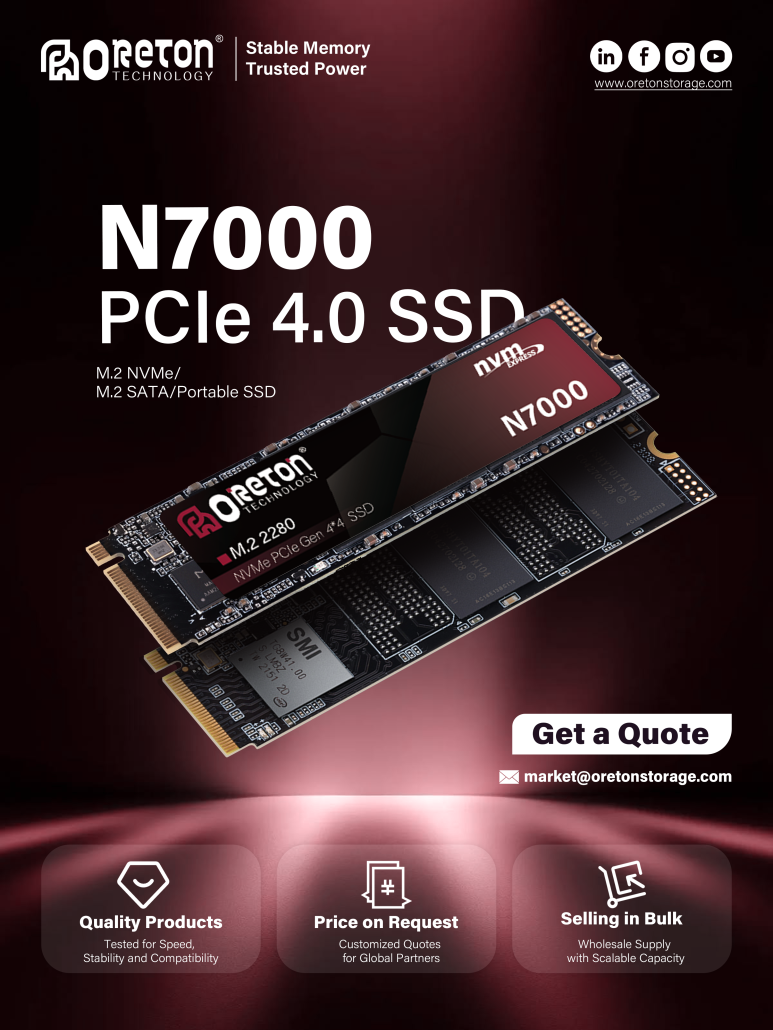
This is particularly relevant for PCIe 4.0 and PCIe 5.0 SSDs.
High-performance NVMe SSDs may require:
- Motherboard heatsinks
- Dedicated SSD heatsinks
- Better airflow
- Thermal throttling management
For distributors, this creates an opportunity to differentiate products not only by performance but also by the overall thermal solution.
Par exemple :
PCIe 4.0 + Efficient Thermal Design
ou
PCIe 5.0 + High-Performance Heatsink
can provide clearer product positioning.
12. Supply Stability Should Influence Portfolio Planning
Product portfolio planning is also a supply-chain decision.
Distributors need to consider:
- NAND availability
- Controller supply
- Production capacity
- Lead time
- MOQ
- Inventory turnover
- Price fluctuations
A product that performs well but cannot be supplied consistently may not be suitable as a core distribution SKU.
For long-term channel sales, distributors should balance:
Market Demand + Product Performance + Supply Stability
13. Build a Portfolio Instead of Chasing One Product
A strong SSD distribution portfolio can follow a simple structure:
Tier 1 — Entry
SATA SSD
Focus:
Compatibility + Affordable Upgrade
Tier 2 — Value NVMe
PCIe 3.0
Focus:
NVMe Performance + Cost Efficiency
Tier 3 — Mainstream
PCIe 4.0
Focus:
Gaming + Performance + Broad Market Demand
Tier 4 — Premium
PCIe 5.0
Focus:
High Performance + Enthusiast + Professional Applications
This structure allows distributors to address multiple market segments without relying on a single product generation.
14. A Practical SSD Portfolio for Distributors
For a general PC hardware distributor, a balanced portfolio could look like:
SATA
240GB / 480GB / 1TB
↓
PCIe 3.0
512GB / 1TB / 2TB
↓
PCIe 4.0
512GB / 1TB / 2TB / 4TB
↓
PCIe 5.0
1TB / 2TB / 4TB
The exact combination should be adjusted according to regional demand, customer requirements and inventory conditions.
The purpose is not to offer every possible configuration.
The purpose is to ensure that every major customer segment has an appropriate product.
15. Oreton’s SSD Product Portfolio
For a manufacturer, supporting distribution channels requires more than developing individual SSD products.
Oreton’s SSD portfolio can be structured across different performance and application segments.
SATA SSD
Designed for:
- PC upgrades
- Office systems
- Older platforms
- Cost-sensitive applications
PCIe 3.0 NVMe SSD
Designed for:
- Mainstream PCs
- Budget gaming
- Laptop upgrades
- Value-oriented systems
PCIe 4.0 NVMe SSD
Designed for:
- PC de jeu
- Ordinateurs de bureau performants
- Création de contenu
- Mainstream high-performance systems
PCIe 5.0 NVMe SSD
Designed for:
- Enthusiast gaming
- High-end workstations
- New-generation platforms
- Performance-focused systems
This product structure allows distributors and OEM customers to select products according to their target market rather than forcing every customer toward the highest specification.
Conclusion
For SSD distributors, a successful product strate

gy is not simply about offering the newest interface.
SATA, PCIe 3.0, PCIe 4.0 and PCIe 5.0 each have a role within the market.
The key is to create a clear product ladder based on:
Performance + Capacity + Price + Compatibility + Application + Supply Stability
A well-structured portfolio allows distributors to serve entry-level customers, mainstream PC builders, gaming users and high-performance system integrators without creating unnecessary SKU complexity.
The goal is not to sell the fastest SSD to every customer.
It is to provide the right SSD for the right market segment—and maintain a reliable supply of it.