





In Part 1, we introduced the role of the Power Management IC (PMIC) in DDR5 memory and explained how DDR5 moves part of the power-management function from the motherboard to the memory module.
But understanding what a PMIC does is only the first step.
For memory manufacturers and OEM designers, a more practical question is:
How can PMIC design affect DDR5 memory stability, thermal behavior, and platform compatibility?
A DDR5 memory module is a complete system made up of DRAM ICs, PMIC, PCB, SPD Hub, and other components. Its final behavior also depends on the CPU memory controller, motherboard, BIOS, operating frequency, timings, and workload.
Therefore, PMIC evaluation needs to be considered as part of the complete memory architecture.
1. Why PMIC Matters for DDR5 Stability
Memory stability depends on whether the DRAM devices can consistently operate under their required electrical conditions.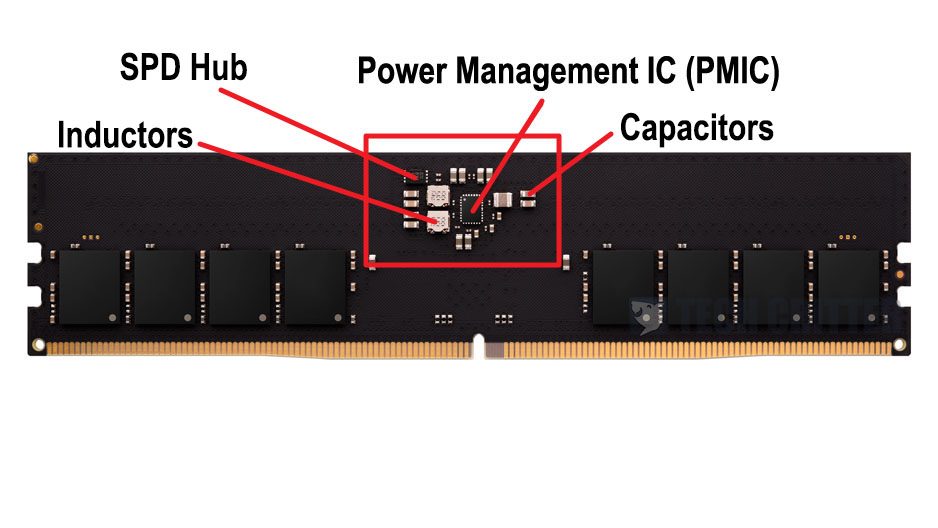
The PMIC plays an important role by managing the power supplied to the memory components.
If the power-management design is not properly matched with the DRAM and module architecture, it can become one of the factors affecting system stability.
However, this does not mean that a PMIC alone determines whether a DDR5 module is stable.
A simplified relationship can be viewed as:
DRAM IC + PMIC + PCB + Memory Controller + BIOS + Thermal Conditions
All of these elements interact during normal operation.
This is particularly important when a memory module is designed for higher operating frequencies or larger capacities.
2. PMIC and Voltage Regulation
One of the primary functions of a DDR5 PMIC is to convert and regulate incoming power for the memory module.
The PMIC needs to maintain appropriate voltage conditions for the DRAM components while the system is operating.
In real-world use, the power requirements of the module are not always completely static.
Different workloads can cause changes in power consumption, while memory frequency, capacity, DRAM configuration, and other design parameters can also affect the electrical requirements.
A well-designed power-management solution therefore needs to respond appropriately to changes in operating conditions.
For OEM designers, this means PMIC specifications should be evaluated together with the actual DRAM configuration rather than considered independently.
3. Higher Frequency Can Increase Design Requirements
As DDR5 frequency increases, the requirements for the complete memory design can become more demanding.
Higher operating frequencies involve tighter timing margins and greater sensitivity to electrical conditions.
Although the PMIC does not directly control memory frequency, the quality of the power-delivery system can contribute to the overall operating environment of the DRAM.
This is why a DDR5 module operating at a higher frequency may require more careful consideration of:
- DRAM IC characteristics
- PMIC behavior
- PCB layout
- Signal integrity
- Memory controller capability
- BIOS configuration
- Thermal conditions
The advertised frequency is therefore only one part of the engineering picture.
4. PMIC and Memory Temperature
Power management and thermal behavior are also connected.
Whenever electrical power is converted or regulated, some energy is dissipated as heat.
The PMIC can therefore become a heat-generating component on a DDR5 module.
Its temperature may be influenced by:
- Input power
- Output power
- Conversion efficiency
- Workload
- Operating frequency
- Module capacity
- Ambient temperature
- PCB design
- Heatsink structure
This means that thermal design should not focus exclusively on the DRAM ICs.
The PMIC and surrounding components should also be considered when designing the thermal structure of a DDR5 DIMM.
5. Why PMIC Placement Matters
The location of the PMIC on the PCB can influence both electrical and thermal design.
The PMIC needs to be connected to the relevant power-delivery paths while also fitting within the physical layout of the module.
Its location can affect:
- PCB routing
- Power-delivery paths
- Component spacing
- Thermal distribution
- Heatsink contact
- Mechanical clearance
For example, if a heatsink is designed primarily around the DRAM chips, the thermal relationship between the heatsink and the PMIC should also be considered.
This becomes more important when the module operates under sustained workloads.
6. PMIC and Heatsink Design
A DDR5 heatsink is not simply a decorative cover.
Depending on the module design, it can help transfer heat away from both the DRAM components and other heat-generating parts.
However, thermal performance depends on the complete structure.
A simplified thermal path can be represented as:
Component → Thermal Interface → Heatsink → Airflow
The effectiveness of this path depends on factors such as:
- Thermal interface material
- Contact area
- Component height
- Heatsink design
- Airflow
- Ambient temperature
- Workload
The PMIC should therefore be included in thermal analysis when its power dissipation is significant.
7. PMIC Quality Does Not Exist in Isolation
When evaluating a PMIC, it can be tempting to focus only on individual specifications.
But a PMIC that performs well in one memory design does not automatically produce the same result in another design.
Der Grund dafür ist einfach:
The surrounding components and operating conditions are different.
For example, two DDR5 modules may use different DRAM ICs, PCB layouts, capacities, and frequencies.
Even if they use the same PMIC, their final electrical and thermal behavior may still be different.
Similarly, using a different PMIC does not automatically make a module more stable or higher performing.
The PMIC needs to be evaluated as part of the complete module.
8. Platform Compatibility Is Another Important Factor
DDR5 memory does not operate independently from the system.
The module interacts with the CPU’s integrated memory controller, motherboard, BIOS, and other platform components.
This means a memory module can behave differently across different platforms.
For example, a DDR5 module may operate normally at a particular frequency on one platform while requiring different settings or operating conditions on another.
Possible factors include:
- CPU memory controller capability
- Motherboard design
- BIOS version
- Memory training
- DIMM slot configuration
- DRAM IC characteristics
- PMIC behavior
- Operating frequency and timings
Therefore, memory compatibility should be evaluated at the platform level.
9. PMIC and Memory Training
Memory training is another part of DDR5 platform behavior.
During system startup, the memory controller and platform firmware may perform a series of initialization and parameter-adjustment processes to establish stable memory operation.
The PMIC is not responsible for memory training itself.
However, the electrical conditions provided by the memory module are part of the environment in which the memory controller and DRAM operate.
This is why PMIC, DRAM, PCB, BIOS, and memory controller behavior should be considered together when investigating platform compatibility.
A module that passes basic testing on one platform may still require additional validation on another.
10. Capacity Can Also Change the Design Requirements
DDR5 modules are available in different capacities, and different capacity versions may use different DRAM configurations.
For example, a higher-capacity module may use a different DRAM organization or component configuration from a lower-capacity version.
This can affect:
- Power consumption
- Thermal behavior
- Electrical loading
- PCB layout
- Memory training
- Platform compatibility
As a result, manufacturers should not assume that a PMIC and DRAM combination validated on one capacity will automatically behave identically on another.
Each major configuration should be evaluated according to its actual design.
11. Frequency, Timings, and Voltage Work Together
Memory frequency, timings, and voltage should not be considered as completely independent specifications.
Increasing memory frequency can change the electrical and timing requirements of the module.
Likewise, tighter timings can create different operating conditions from a module running at the same frequency with looser timings.
The PMIC contributes to the power environment, but the complete memory system still determines whether the selected frequency and timings can operate reliably.
This is why memory manufacturers need to evaluate the interaction between:
Frequency + Timings + Voltage + DRAM IC + PMIC + Platform
rather than looking at any single specification in isolation.
12. How Should OEM Designers Evaluate DDR5 PMIC Solutions?
For OEM designers, the key question is not simply:
“Which PMIC should we choose?”
A better question is:
“Which PMIC solution is appropriate for our complete memory configuration and target platform?”
Evaluation can include several areas.
Electrical Characteristics
Consider whether the PMIC can provide the required voltage rails and operating conditions for the selected DRAM configuration.
Thermal Behavior
Evaluate PMIC temperature under both normal and sustained workloads.
Plattform-Kompatibilität
Test the module across the intended CPU and motherboard platforms.
Operating Conditions
Check different frequencies, timings, capacities, and system configurations where applicable.
Long-Term Stability
Evaluate the module under extended workloads rather than relying only on short startup or benchmark tests.
This approach provides a more realistic picture of the complete memory solution.
13. What Should DDR5 Stability Testing Include?
A basic memory test can confirm that a module starts and operates correctly.
But OEM validation often needs to go further.
Depending on the application, testing may include:
- System boot and initialization
- Memory training
- Long-duration memory workloads
- Different memory frequencies
- Different timing configurations
- Multiple CPU platforms
- Multiple motherboard platforms
- Different DIMM slot configurations
- Temperature testing
- Repeated system restarts
- Power-cycle testing
- Extended stability testing
The exact test plan should depend on the target application and platform.
The objective is to identify whether the complete memory configuration remains stable under realistic operating conditions.
14. Why Long-Term Testing Matters
A memory module may pass a short benchmark but behave differently during an extended workload.
Long-duration operation can create changes in:
- Temperature
- Power consumption
- Component operating conditions
- Memory controller behavior
This is why short performance tests should not be treated as a complete measure of memory reliability.
For OEM projects, repeatability is also important.
If the same configuration produces significantly different results across repeated tests, the manufacturer may need to investigate the underlying causes.
15. PMIC, DRAM IC, and PCB Need to Be Matched
The PMIC is only one component in a DDR5 DIMM.
The DRAM IC determines the fundamental memory characteristics, while the PCB provides the electrical paths between components.
The PMIC manages the power required by the module.
These elements need to be designed and selected as a compatible combination.
A simplified design relationship is:
DRAM IC → PCB Design → PMIC → Thermal Structure → Platform
Changes to one part may require adjustments or additional validation elsewhere.
This is especially important for OEM products where capacity, frequency, module size, and platform requirements may be customized.
16. Different OEM Applications May Need Different Solutions
There is no single DDR5 configuration that is ideal for every application.
An OEM system may have different requirements depending on its:
- CPU platform
- Motherboard
- Memory capacity
- Operating frequency
- Physical dimensions
- Thermal environment
- Workload
- Cost target
For example, a high-frequency desktop memory module and a space-constrained embedded system may have very different thermal and electrical requirements.
The PMIC solution should therefore be selected according to the complete product design.
17. What Memory Manufacturers Should Look at Beyond the PMIC
When developing a DDR5 memory module, manufacturers need to consider more than the PMIC itself.
A practical evaluation framework includes:
1. DRAM IC
Capacity, density, characteristics, and availability.
2. PMIC
Power conversion, regulation, thermal behavior, and compatibility.
3. PCB
Layout, routing, signal integrity, and power delivery.
4. Thermal Design
Heatsink, thermal interface, component placement, and airflow.
5. Platform
CPU memory controller, motherboard, BIOS, and memory training.
6. Validation
Performance, stability, temperature, compatibility, and repeatability.
This system-level approach is particularly important when developing products for multiple platforms or OEM customers.
18. Oreton’s Approach to DDR5 Memory Stability
At Oreton, we believe DDR5 memory stability should be evaluated from the complete module and platform perspective.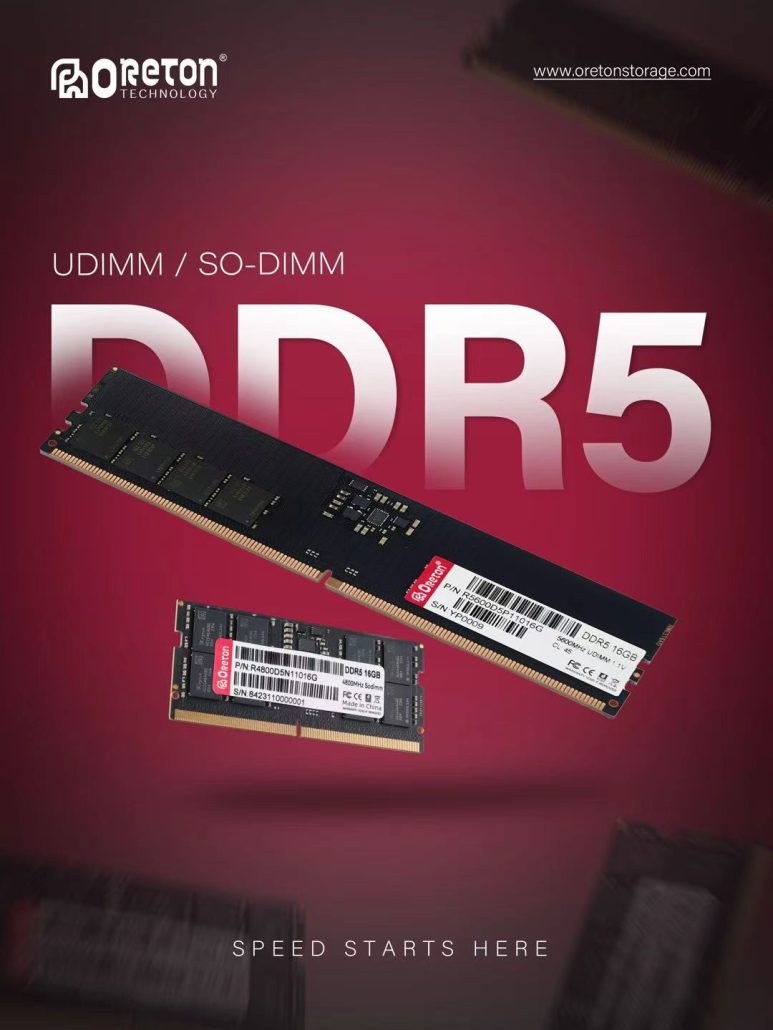
PMIC selection is considered together with DRAM ICs, PCB design, module configuration, thermal structure, and target platforms.
For OEM projects, different specifications may require different validation approaches.
Rather than evaluating a module only through its advertised capacity and frequency, we also consider how the complete configuration behaves under its intended operating conditions.
The goal is to achieve a practical balance between performance, compatibility, stability, thermal behavior, and product consistency.
Schlussfolgerung
The DDR5 PMIC plays an important role in managing power on the memory module, but its influence cannot be separated from the rest of the system.
PMIC, DRAM IC, PCB, thermal design, memory controller, BIOS, and workload all contribute to the final operating behavior of a DDR5 memory module.
For OEM designers, PMIC selection should therefore be part of a broader validation process rather than treated as an isolated component decision.
A reliable DDR5 solution requires more than reaching a target frequency. It requires the complete memory architecture to work consistently across the intended platform and operating conditions.
From power management to thermal behavior and platform compatibility, every part of the DDR5 module needs to work together.