





مقدمة
When selecting a modern SSD, performance numbers are often the first thing users look at.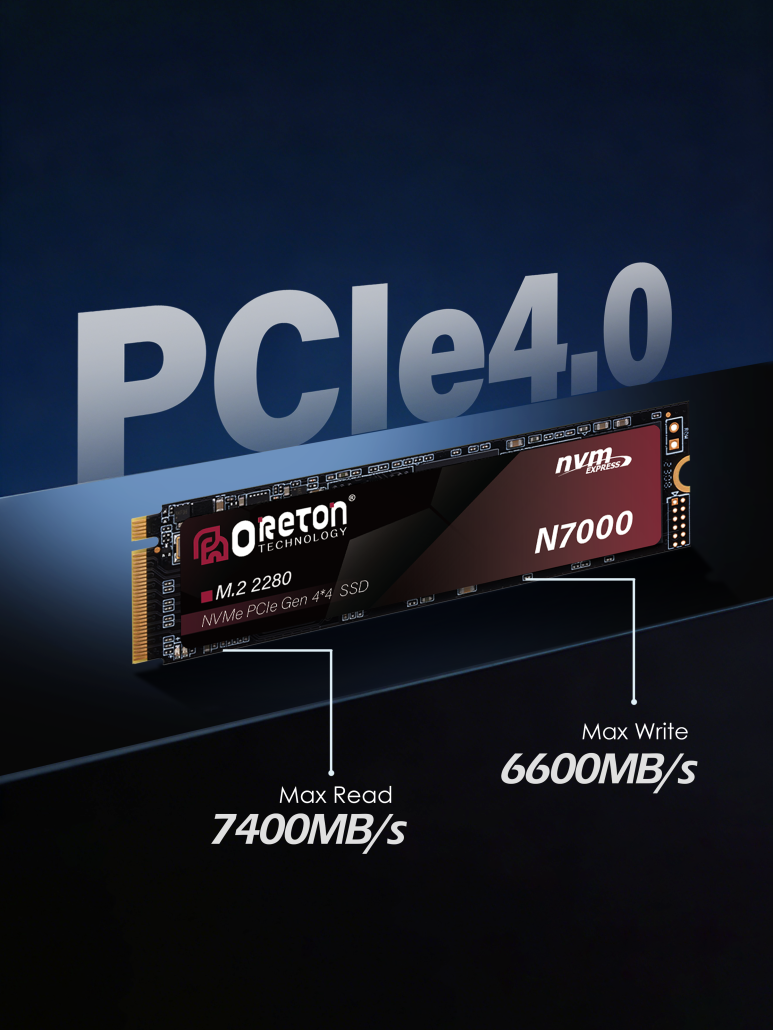
Specifications such as:
- 7,400 MB/s read speed
- 6,500 MB/s write speed
- 14,000 MB/s read speed
have become common highlights in SSD marketing.
These numbers demonstrate the maximum capability of a storage device under ideal testing conditions. However, in real-world environments, SSD performance is not always determined by the highest speed achieved during a short benchmark.
Many users experience situations like:
- A file transfer starts extremely fast but slows down after several minutes.
- A game installation speed decreases halfway through.
- Video editing workloads become less responsive during long exports.
- Large project files take much longer than expected to move or process.
These differences are related to one important performance factor:
Sustained write performance.
Unlike peak benchmark results, sustained write performance measures how consistently an SSD can maintain write speeds during extended workloads.
For gamers, content creators, professionals, and businesses handling large amounts of data, stable long-term performance is often more important than short bursts of maximum speed.
Peak Speed vs Sustained Performance: Two Different Measurements
SSD performance testing usually focuses on sequential read and write speeds.
Sequential performance measures how quickly an SSD can handle large continuous blocks of data.
على سبيل المثال:
- Copying a large video file
- Loading a large game library
- Moving database files
This type of workload is ideal for showing maximum SSD capability.
However, benchmark results are usually measured under controlled conditions:
- Fresh SSD state
- Short testing duration
- Optimized temperature
- Limited data volume
Under these conditions, an SSD can achieve its highest advertised speed.
But real-world workloads are often different.
A user may transfer hundreds of gigabytes of data continuously, causing the SSD to experience:
- Cache limitations
- Increasing controller workload
- Higher temperatures
- More intensive NAND operations
At this point, sustained performance becomes the more meaningful measurement.
A high-quality SSD is not only about reaching a high peak speed—it is about maintaining reliable performance when the workload continues.
Understanding SSD Write Operations
To understand sustained write performance, it is important to understand how an SSD stores data.
An SSD consists of several key components:
- NAND Flash Memory
- SSD Controller
- Firmware
- Cache System
- PCB
When data is written to an SSD, the controller manages how information is distributed across NAND flash.
The process involves:
- Data allocation
- Error correction
- Wear leveling
- Garbage collection
- NAND management
Unlike traditional hard drives, SSDs do not simply write data to a fixed location.
The controller continuously manages storage operations to improve:
- الأداء
- الموثوقية
- Lifespan
During short workloads, these processes can be handled efficiently.
However, during long continuous writes, the SSD must perform more complex operations, which can affect performance.
SLC Cache: Why SSD Speed Drops During Large Transfers
One of the most important factors affecting sustained write performance is SLC Cache.
Many modern consumer SSDs use TLC NAND or QLC NAND.
However, part of the NAND capacity can temporarily operate as SLC cache.
SLC stores one bit per cell, allowing faster write operations compared with multi-level NAND technologies.
During short transfers, the SSD writes incoming data into this faster cache area first.
This creates the high write speeds users often see in benchmarks.
على سبيل المثال:
A user copies a 20GB file.
The SSD may maintain near-maximum write speed because the available SLC cache can handle the workload.
However, if the user continues transferring:
- 100GB
- 200GB
- 500GB
the cache eventually becomes full.
Once this happens, the SSD must write directly to NAND flash.
This is known as:
Cache exhaustion.
After cache exhaustion, write speeds may decrease significantly depending on:
- NAND type
- سعة محرك الأقراص SSD
- Controller performance
- تحسين البرامج الثابتة
This does not mean the SSD is failing.
It is a normal behavior of modern SSD architecture.
The difference between SSD designs is how effectively they manage performance after the cache is exhausted.
NAND Flash Technology and Its Impact on Sustained Performance
NAND flash selection plays a major role in SSD performance.
Different NAND technologies have different characteristics.
TLC NAND
TLC (Triple-Level Cell) stores three bits per NAND cell.
المزايا:
- Good balance between speed and capacity
- Better endurance compared with higher-density NAND
- Suitable for performance-focused SSDs
TLC NAND is widely used in gaming SSDs, professional storage, and high-performance consumer products.
QLC NAND
QLC (Quad-Level Cell) stores four bits per cell.
المزايا:
- Higher storage density
- Lower cost per gigabyte
ومع ذلك:
- Native write performance is generally lower than TLC
- Sustained workloads may experience larger performance changes after cache exhaustion
For users who frequently handle large files or professional workloads, NAND selection becomes especially important.
A reliable SSD manufacturer must consider the relationship between:
- NAND type
- القدرة الاستيعابية
- Controller capability
- ضبط البرامج الثابتة
to achieve balanced performance.
SSD Controller: The Key to Performance Management
The SSD controller acts as the brain of the storage device.
It manages almost every important SSD operation:
- Communication between NAND chips
- Data processing
- Error correction
- Cache management
- Wear leveling
- Garbage collection
During sustained workloads, the controller becomes increasingly important.
A powerful controller can improve:
Cache Management
Efficiently moving data between cache and NAND.
Data Distribution
Maintaining balanced NAND usage.
Error Handling
Ensuring data reliability during intensive operations.
Performance Stability
Reducing large fluctuations during continuous workloads.
This is why two SSDs using similar NAND technology can still deliver different real-world performance.
The controller and firmware optimization can significantly influence sustained write behavior.
SSD Capacity Also Affects Sustained Performance
SSD capacity is another factor that users often overlook.
Different capacity versions of the same SSD model may not always perform identically.
Higher-capacity SSDs usually contain more NAND flash packages, which can provide:
- Greater parallelism
- Improved workload distribution
- Higher sustained performance
على سبيل المثال:
A 2TB SSD may maintain stronger long-duration write performance compared with a lower-capacity version because more NAND resources are available.
This is why professional workloads often benefit from larger-capacity SSDs.
Thermal Management and Performance Stability
Heat is another major factor influencing sustained performance.
During long write operations, the SSD controller continuously processes data, generating heat.
If temperatures become too high, the SSD activates:
Thermal throttling.
Thermal throttling reduces operating speed to prevent overheating and protect the hardware.
Users may notice:
- Lower transfer speeds
- Longer rendering times
- Reduced consistency during heavy workloads
Effective thermal management helps maintain stable performance by controlling:
- Controller temperature
- Power consumption
- Long-term workload stability
This is especially important for modern high-performance NVMe SSDs.
Why PCIe Gen4 and Gen5 SSDs Need Better Thermal Design
As SSD interfaces continue evolving, performance levels have increased dramatically.
PCIe Gen3 SSD
Typical performance:
- Around 3,000+ MB/s read speed
Suitable for:
- Everyday computing
- Office systems
- General gaming
PCIe Gen4 SSD
Modern Gen4 SSDs can exceed:
- 7,000 MB/s read speed
Benefits:
- Faster game loading
- Improved content creation workflows
- نقل الملفات بسرعة أكبر
However, higher performance also creates more heat.
PCIe Gen5 SSD
Next-generation Gen5 SSDs can reach:
- 10,000–14,000+ MB/s performance levels
These drives provide extremely high bandwidth for:
- أحمال عمل الذكاء الاصطناعي
- إنشاء المحتوى الاحترافي
- محطات العمل
But maintaining this level of performance requires:
- Better controllers
- Improved firmware
- Effective cooling solutions
For Gen5 storage, sustained performance becomes even more important because users expect consistent high-speed operation, not only short benchmark results.
Real-World Examples: Where Sustained Performance Matters
Video Editing and Content Creation
Professional creators often work with:
- 4K video
- 8K video
- Large project files
A short burst of high speed is useful, but long exports and file transfers require stable performance.
An SSD that maintains consistent write speeds can reduce:
- Project transfer times
- Export delays
- Workflow interruptions
الألعاب
Modern games continue increasing in size.
Large installations and updates often involve hundreds of gigabytes of data.
Sustained performance affects:
- Installation speed
- Game library management
- Large update processes
AI and Professional Computing
AI workloads often involve:
- Large datasets
- Continuous data loading
- Model files
These applications require storage that can handle extended workloads without significant performance drops.
How Oreton Designs SSD Performance for Real-World Use
At Oreton, SSD performance is not defined only by maximum benchmark numbers.
A reliable storage solution requires a balanced approach across multiple areas:
Controller Selection
Choosing controllers that provide efficient data management and stable operation.
NAND Quality
Selecting NAND solutions that balance performance, endurance, and reliability.
Firmware Optimization
Improving communication between controller and NAND to maintain consistent performance.
Thermal Consideration
Designing products that can operate reliably during demanding workloads.
Validation Testing
Evaluating SSD performance under different usage scenarios.
إن Oreton N7000 PCIe Gen4 NVMe SSD is designed for users who require high-speed storage for gaming, content creation, and professional computing.
With PCIe Gen4 performance, optimized components, and reliability-focused design, N7000 aims to provide not only fast response times but also stable performance during extended workloads.
As PCIe Gen5 SSD technology continues developing, Oreton continues focusing on the same principle:
Performance should not only be fast—it should remain consistent when users need it most.
الخاتمة
SSD benchmarks provide valuable information, but they do not tell the complete story.
Peak speed shows what an SSD can achieve under ideal conditions.
Sustained write performance shows how the SSD performs during real-world workloads.
Factors including:
- SLC cache behavior
- NAND technology
- SSD controller
- تحسين البرامج الثابتة
- الإدارة الحرارية
- سعة محرك الأقراص SSD
all influence long-term performance.
For users who regularly handle large files, professional applications, gaming libraries, or AI workloads, choosing an SSD with strong sustained performance ensures a faster, more reliable computing experience.
The best SSD is not only the one that reaches the highest speed—it is the one that continues delivering stable performance when the workload becomes demanding.